
A hospital group with five branches across different cities was facing a serious communication challenge. Each location had a separate virtual & toll free phone number, separate reception teams, and no centralized monitoring. Patients often called the wrong branch. Some calls went unanswered during peak hours. Appointment confirmations were handled manually.
For hospital management, this was more than just a phone problem — it was a patient experience problem.
This is where Cloud Telephony for Hospitals changes the game. It allows multi-location hospitals to operate on one unified communication system, without changing physical infrastructure at every branch.
Let’s understand how this works from a hospital industry point of view.
Communication Challenges in Multi-Location Hospitals
Managing communication across multiple hospital branches is complex. When systems are disconnected, problems multiply.
Missed Patient Calls
During peak hours, reception desks are overloaded. When phone lines are busy, calls are missed. For hospitals, one missed call can mean:
- A lost patient appointment
- A delayed treatment
- A frustrated patient
- Lost Revenue
Without a proper Hospital Call Management System, tracking missed calls becomes difficult.
Different Numbers for Each Branch
Many hospital chains use separate local phone numbers for each location. This creates confusion:
- Patients don’t know which phone number to call
- Central monitoring is not possible
A Centralized Call System solves this by offering one main number for all branches.
No Real-Time Monitoring
Hospital administrators cannot create a proper monitor report:
- How many calls each branch receives
- Average call handling time
- Missed vs answered call ratio
- No call recoding
- Emergency Call
Without proper data and monitoring, improvement becomes guesswork.
Call Overflow Issues
If one branch receives heavy call volume while another branch has idle staff, there is no way to balance the load in traditional systems.
Manual Appointment Coordination
Hospital front desk receptionists manually write down appointments or update separate systems. This increases:
- Human errors
- Double bookings
- Delayed confirmations
- No proper reminder
- Over workload
A unified Hospital Appointment Management System reduces these risks.
Unify All Your Hospital Branches with One Smart Communication System
 Reduce Missed Patient Calls
Centralized Appointment Management
Real-Time Monitoring Across All Locations
Reduce Missed Patient Calls
Centralized Appointment Management
Real-Time Monitoring Across All LocationsUnify All Your Hospital Branches with One Smart Communication System
Reduce Missed Patient Calls
Centralized Appointment Management
Real-Time Monitoring Across All LocationsWhat is Cloud Telephony in Healthcare?
Cloud Telephony is a cloud communication system that works over the internet instead of traditional phone lines. Hospitals do not need heavy hardware or complex wiring.
In simple terms, it is a Virtual Phone System for Hospitals that connects all branches, departments, and staff on one cloud-based platform.
How It Works:
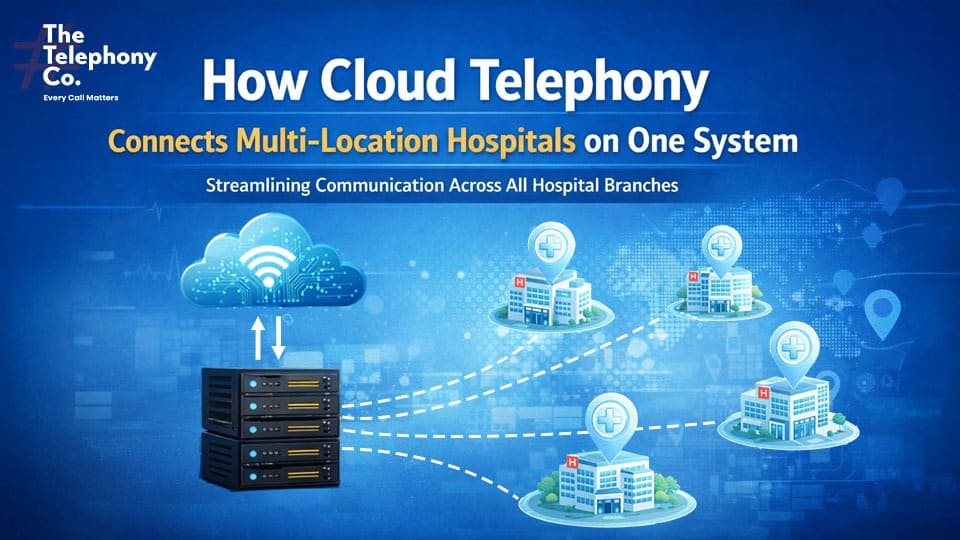
- A central cloud server manages all calls
- Calls are routed automatically to the right department
- Administrators can monitor everything through a dashboard
- Staff can answer calls from desk phones, mobile phones, or softphones
Unlike traditional PBX systems:
- No large hardware investment
- Easy to scale
- Works across cities
This becomes a complete Healthcare Communication Solution

How Cloud Telephony Connects All Hospital Branches on One System
1. Single Centralized Number
Instead of using different phone numbers, hospitals can use one main virtual and toll free number for all branches.
When a patient calls:
- IVR (Press 1 for Delhi, Press 2 for Mumbai, or other)
- Or the system automatically routes based on location
This creates a unified brand presence and improves trust.
2. Smart Call Routing
With advanced Call Routing for Hospitals, calls go directly to the correct department:
- Emergency
- OPD
- Billing
- Diagnostic Center
- Blood bank
Rules can be set based on:
- Time of day
- Department availability
- Branch workload
3. IVR for Hospitals
(Interactive Voice Response) IVR number automates the first level of communication.
Example:
- Press 1 for Appointments
- Press 2 for Reports
- Press 3 for Emergency
This reduces receptionist workload and improves patient experience.
4. Centralized Call Monitoring Dashboard
Hospital management can see:
- Total calls across all branches
- Missed calls
- Call recordings
- Staff performance
- Total Appointment Book
This unified dashboard makes it a true Unified Communication Platform.
5. Shared CRM & Appointment Integration
Cloud Telephony system can integrate with hospital management software.
When a patient calls:
- Their data pops up automatically
- Appointment history is visible
- Booking can be done instantly
- Number of queries handled per day
6. Call Overflow Management
If one branch is overloaded:
- Calls can be redirected to another branch
- Or to a centralized call center
This is how a Cloud-based Call Center for Hospitals supports multiple locations efficiently.
Key Benefits of Cloud Telephony for Multi-Location Hospitals
Now let’s understand the practical benefits of a cloud telephony system from a hospital management perspective.
✔ Improved Patient Experience
Patients don’t care which branch they call. They expect fast response. A connected system ensures:
- Quick routing
- Less waiting time
- Professional communication
- AI Voice bot book appointment
✔ Reduced Missed Calls
Automated routing and overflow handling reduce call loss significantly. Many hospitals report up to 30–40% improvement in answered calls after switching to a Hospital Call Management System.
✔ Better Staff Productivity
Reception teams focus on patient care instead of manually transferring calls.
✔ Data-Driven Decisions
With call analytics, administrators can:
- Identify peak hours
- Plan staff shifts
- Improve department performance
✔ Cost Savings
No need for expensive hardware at every branch. Cloud systems are scalable and cost-effective.
Real-World Example: Multi-Branch Hospital Group
A 4-branch hospital group faced 40% to 50% missed calls due to busy lines. That was the reason for slow appointment bookings. Each branch operated independently.
After implementing Cloud Telephony for Hospitals:
- One centralized global number was introduced
- IVR System was configured
- Calls were routed based on branch availability
- Missed calls were tracked automatically
- Record patient communication
Results within 1 months:
- Missed calls reduced by 80%
- Online and call appointment booking speed improved
- Management gained full visibility
This shows how a centralized Healthcare Communication Solution directly impacts revenue and patient satisfaction.
Connect Every Hospital Branch on One Powerful Cloud System
Advanced Features Hospitals Should Look For Cloud Telephony System
When choosing a Virtual Phone System for Hospitals, certain features are essential.
🔹 Call Recording
Record every patient and receptionist call conversation for quality control and training.
🔹 Call Analytics Dashboard
Track:
- Total inbound calls
- Average handling time (AHT)
- Department performance
🔹 Auto Call Distribution (ACD)
The software divides call flow and automatically distributes calls among available staff.
🔹 Omnichannel Communication in Healthcare
Patients don’t only phone call. They also use:
- SMS
- Other communication platform
A good system supports Omnichannel Communication in Healthcare.
🔹 Department-Wise Routing
Separate routing for:
- Cardiology
- Radiology
- Emergency
- Pharmacy
🔹 SMS & Appointment Reminders
Why Cloud Telephony is the Future of Healthcare Communication
Healthcare is becoming multi-location, multi-specialty, and patient-centric.
Hospitals can no longer operate with disconnected systems. Patients expect:
- Quick response
- AI based appointment booking
- Professional communication
A unified Multi-location Hospital Communication system ensures that every branch operates like one connected network.
Cloud Telephony solution is not just about answering phone calls. It is about:
- Improving operational efficiency
- Increasing appointment conversions
- Enhancing patient trust
- Enabling scalable growth
Conclusion
For hospital groups managing multiple branches, communication is the backbone of patient experience. Disconnected phone systems create confusion, missed calls, and revenue loss.
Cloud Telephony connects all locations on one centralized system, providing visibility, automation, and efficiency. From IVR for Hospitals to intelligent call routing and centralized monitoring, it transforms how healthcare institutions communicate.
If your hospital group is looking to modernize communication and reduce missed patient calls, adopting a reliable cloud-based solution is no longer optional — it is essential.
The Telephony Co provides advanced Cloud Telephony solutions specially designed for multi-location hospitals, helping healthcare organizations operate smarter, faster, and more efficiently.