


Reliable and Advanced Communication Starts with Cloud Telephony
As time changes, everything around us is changing too. So why not upgrade your phone system and switch to cloud telephony?
When you move to the cloud, you save costs and also work faster and smarter. Cloud telephony is also known as VoIP calling or cloud calling. It is hosted on secure cloud servers and managed by a cloud telephony service provider.
Businesses can use cloud telephony through the internet on devices such as:
- Mobile phones
- Laptops
- Desktop computers
- IP desk phones
With the rise of Unified Communications as a Service (UCaaS), traditional PBX (Private Branch Exchange) phone systems are slowly being replaced. Cloud telephony has become the new standard for modern business communication.
Cloud telephony plays an important role in improving business communication. It has completely changed the way businesses connect with customers and teams. It works on a web browser or mobile app; it makes work much easier and more flexible.
Cloud telephony allows businesses to manage calls, IVR, call routing, call recordings, and analytics from a simple web-based or app-based dashboard. There is no need to install expensive hardware or equipment.
If you feel the time has come to leave your old phone system and move to the cloud telephony service, this article will guide you completely. We will explain what cloud telephony is, how it works, how it benefits your business, what features it offers, and how to choose the right cloud telephony service provider—everything you need to know in one place.
Ready to Modernize your Business Communication?
Get Started with Cloud Telephony Today
 Secure & Reliable Calling
Reduce Operational Costs
Better Customer Experience
Secure & Reliable Calling
Reduce Operational Costs
Better Customer ExperienceReady to Modernize your Business Communication? Get Started with Cloud Telephony Today
Secure & Reliable Calling
Reduce Operational Costs
Better Customer ExperienceWhat Is Cloud Telephony?
Cloud telephony is a modern and advanced communication solution designed for today’s businesses. It works over the internet instead of traditional phone lines and is also known as hosted telephony or VoIP-based calling.
Powered by VoIP (Voice over Internet Protocol) technology, cloud telephony allows businesses to make and receive calls from anywhere using an internet connection. Unlike old landline systems that rely on physical wires and heavy hardware, cloud telephony offers a flexible, fully cloud-based calling experience.
As part of Unified Communications as a Service (UCaaS), cloud telephony brings multiple communication tools together on one powerful platform. It helps businesses manage calls, teams, and customers more efficiently—all from a single dashboard.
With cloud telephony, businesses unlock advanced features such as virtual local and toll-free numbers, smart call forwarding, intelligent call routing, IVR, call monitoring, call recording, and real-time analytics. These features not only improve customer experience but also increase team productivity.
Cloud telephony has transformed business communication completely. It moves your entire communication system to the cloud, eliminating the need for expensive on-premises hardware and complex installations.
 Also Read: Best Cloud Telephony Provider
How Does Cloud Telephony Work?
Cloud telephony works by using the internet instead of traditional phone lines to make and receive calls. It uses VoIP (Voice over Internet Protocol) technology to convert voice into digital data and transmit it securely over the internet.
Here’s a simple step-by-step explanation:
Call Initiation
When a user makes a call, the voice is captured through a device such as a mobile phone, laptop, desktop, or IP phone.
Voice to Data Conversion
The system converts the voice into digital signals using VoIP (Voice over Internet Protocol) technology.
Cloud Processing
These digital signals are sent to secure cloud servers managed by the cloud telephony service provider. The system processes the call, applies call routing rules, IVR menus, or forwarding settings.
Call Routing
The call is intelligently routed to the right agent, department, or device based on predefined rules like time, location, or availability.
Call Connection
The call reaches the receiver on their chosen device through the internet, ensuring clear and uninterrupted communication.
Call Management & Analytics
All calls can be monitored, recorded, and analyzed through a web-based or app-based dashboard. Businesses can track performance, customer interactions, and call quality in real time.
Top 8 Benefits of Cloud Telephony for Business Communication
If you are still using an old phone system for your business communication, you are already falling behind your competitors. Traditional phone systems can lead to lost customers, missed sales opportunities, poor customer experience, and higher communication costs.
You may be surprised to know that all these problems can be easily solved by switching to a cloud telephony solution. Cloud telephony helps businesses upgrade their communication, improve efficiency, and move to the next level.
By understanding the key benefits of cloud telephony, you can protect your business from communication gaps, reduce missed calls, improve sales and customer support, and avoid revenue loss. Its is designed to strengthen your communication, sales, and support teams, while delivering a better experience to your customers.
Let’s explore the top 8 benefits of cloud telephony and see how it can transform the way your business communicates.
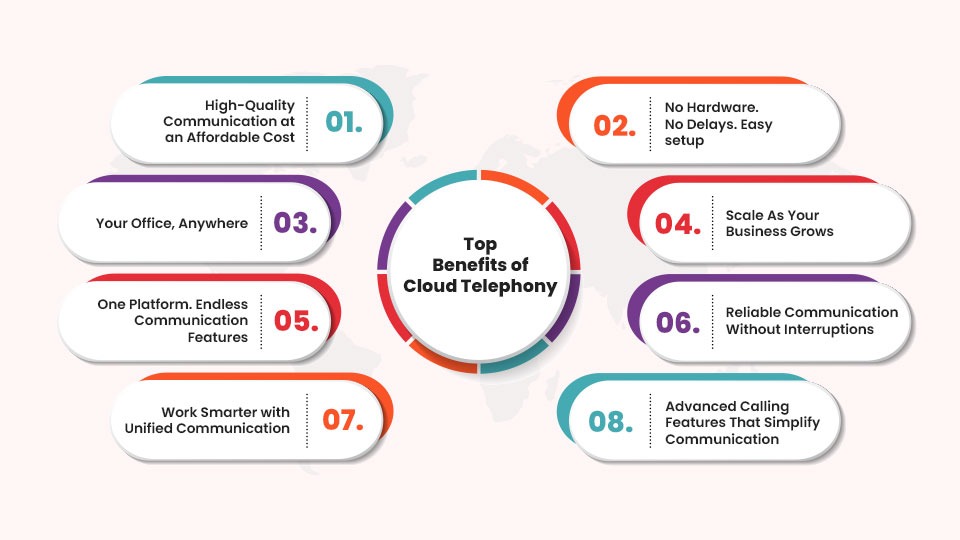
1. High-Quality Communication at an Affordable Cost
Stop overpaying for outdated phone systems. Traditional calling setups come with high bills, costly maintenance, and limited flexibility. By switching to cloud telephony, businesses can save communication costs by up to 70%—without compromising on call quality.
Instead of paying separately for different services, cloud telephony offers an all-in-one communication platform. Get virtual local and toll-free numbers, SMS services, IVR Number, and VoIP-based calling in a single, cost-effective solution.
2. No Hardware. No Delays. Easy setup
Setting up cloud telephony requires no effort from your business. Everything is fully managed by the service provider, and your phone system can be up and running within a single day.
There is no need for heavy infrastructure, IT support team, multiple phone lines, expensive hardware, or a dedicated technical team. Everything is handled by The Telephony Co’s cloud telephony service.
You receive a dedicated business phone number, including virtual local and toll-free numbers tailored to your business needs, along with an easy-to-use web-based and app-based dashboard. This allows you to manage calls, users, and settings effortlessly from anywhere.
3. Your Office, Anywhere
Cloud telephony has become a must-have solution for companies because most businesses are now adopting remote work and giving employees more flexibility.
Employees are no longer tied to one office location. They can use their office phone system from anywhere, as long as they have a strong internet connection.
Cloud telephony is not limited to calling only. Employees can send messages, host meetings, forward calls, manage call routing, make video calls, and check voicemail—anytime and from anywhere.
Cloud telephony is the perfect solution for companies that have offices in multiple countries or in different states, or teams working remotely.
4. Scale As Your Business Grows
Those days are gone when companies had to buy new phone numbers, add phone lines, or set up complex hardware every time a new employee joined.
Cloud telephony works according to your business needs. You can easily add or remove users, numbers, and features without any complicated setup.
Whether your team grows from 5 to 50 or expands to new locations, cloud telephony adapts smoothly and supports your business growth without interruptions.
Also Read: What Is a Contact Center?
5. One Platform. Endless Communication Features
Cloud telephony gives businesses powerful features and functionality that were impossible to imagine with old traditional phone systems.
Businesses can benefit from advanced features like smart call routing, call forwarding, voicemail, call analytics dashboards, call recording, video calls, and team messaging—all designed to improve communication and productivity.
To deliver better customer support, companies can design multi-level IVR solutions based on their business needs, ensuring every call reaches the right department quickly.
All features work together on one platform, helping your team respond faster, collaborate better, and provide a smooth and professional customer experience.
6. Reliable Communication Without Interruptions
Think about situations like power failure, cable cuts, network issues, or technical faults. All these problems can seriously damage your organization and even cause you to lose customers.
Trusted cloud telephony solution providers like The Telephony Co deliver 99.99% uptime, so your business communication always stays active. If one cloud server goes down, your service is automatically switched to another server without any interruption.
With multiple backups and failover systems in place, cloud telephony keeps your business connected—anytime, anywhere, without disruption.
7. Work Smarter with Unified Communication
Modern businesses can no longer afford to use multiple platforms for different tasks—one for calls and meetings, another for chats and messages, and a separate system for analytics and reports. This disconnected way of working slows teams down, wastes valuable agent time, and reduces efficiency.
Cloud telephony brings everything together on a single, easy-to-use interface. With Unified Communication (UC), your team can handle calls, messages, emails, and meetings from one platform without switching tools.
It also provides real-time data, performance insights, smooth team collaboration, and quick feedback. As a result, your team works faster, stays focused, and delivers a consistent and professional customer experience.
8. Advanced Calling Features That Simplify Communication
Advanced calling features of cloud telephony help agents work in a smarter way. They reduce manual effort, speed up daily tasks, and allow agents to focus on the right work.
Cloud telephony offers many powerful calling features under one platform. These include
- IVR (Interactive Voice Response)
- Call Forwarding & Call Recording
- Click-to-Call & Conference Calling
- Voicemail to Email
- Automatic Call Distribution (ACD)
- Missed Call Alerts
- Virtual (Local & Toll-Free Numbers)
- AI Auto-Attendant
All these features work together like one complete system. They simplify business communication, improve call handling, and help teams deliver a smooth and professional customer experience.
One Cloud Platform for All Your Business Communication Needs
One Cloud Platform for All Your Business Communication Needs
10 Cloud Telephony Features That Make Business Communication Easy
Let’s talk about the advanced features that come with cloud telephony. These features are provided by the service provider and make communication easier not just for agents but also for customers.
These features work together as a complete system. They simplify business communication, improve customer service, and help your business grow—without juggling multiple tools or platforms.
These advanced features make business calls faster, simpler, and more efficient.
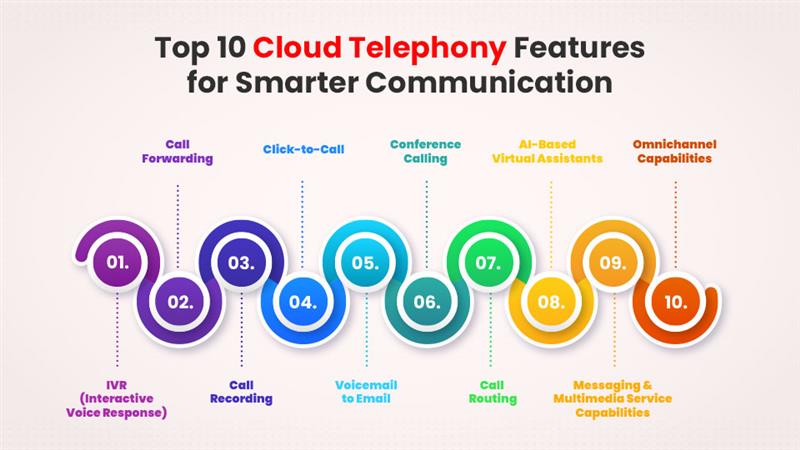
1. IVR (Interactive Voice Response)
IVR, also known as “Press 1 calling,” is one of the most powerful features of cloud telephony. It allows customers to choose services on their own by selecting menu options. This helps route the call to the right agent or department without manual effort.
When a business uses an IVR number, it can easily manage a large number of incoming calls. The IVR solution reduces customer waiting time and ensures that calls reach the correct agent or team.
2. Call Forwarding
Call forwarding may sound like a small feature, but it is an important part of cloud telephony. With the help of this feature, call centers and service-based companies can forward incoming calls to the most suitable agent, team, or specific department based on their needs.
This helps make sure calls are handled by the right people at the right time. As a result, customers get faster responses, and businesses can manage calls more efficiently without missing important conversations.
3. Call Recording
When we talk about cloud telephony, call recording is a feature that cannot be ignored. With automatic call recording, businesses can record both incoming and outgoing calls without any manual effort.
Through call recording, businesses can keep a record of every conversation. These recordings help managers review calls, identify gaps, and resolve disputes or misunderstandings. They are also useful for training new agents, improving call quality, and maintaining service standards.
4. Click-to-Call
Cloud telephony’s Click-to-Call feature allows agents to connect with customers directly from a CRM system or website without manual dialing. With just one click, calls are placed instantly, making the calling process faster and easy.
Click2call service saves valuable time for agents and reduces dialing mistakes to almost zero. As a result, agents can focus more on conversations instead of dialing numbers, and businesses can improve productivity and customer experience.
5. Voicemail to Email
In simple terms, cloud telephony converts voicemail messages into audio files and sends them directly to the email inbox. This makes the voicemail process easy and well organized.
Agents can listen to voicemails anytime, from anywhere, and reply quickly. Voicemail files can also be downloaded and easily shared with other team members when needed.
Also Read: What is a VoIP Number ?
6. Conference Calling
For businesses that have offices or customers in multiple countries, cloud telephony makes conference calling simple. With this feature, multiple people can join a single call at the same time.
Through cloud telephony service, businesses can also conduct virtual meetings, video conferencing, and screen sharing. This helps teams collaborate better, save travel time, and communicate effectively from anywhere.
7. Call Routing
Cloud telephony is not just about making calls. It also gives businesses the power of call routing, which sends incoming calls to the right agent, team, or department automatically, based on predefined rules.
Calls can be routed by Skill-Based, Time-based, Location-based, work shifts, agent availability, language-based, or customer needs. This reduces unnecessary call transfers and long waiting times. As a result, customers get faster responses and better support, and businesses can manage calls more efficiently.
8. AI-Based Virtual Assistants
AI-based virtual assistants can handle call routing, common questions, and appointment scheduling. They manage routine customer queries on their own, so organizations do not need a large support team, which helps lower operational costs.
This feature allows human agents to focus on more complex and important calls. As a result, customer support becomes faster, more efficient, and of much better quality.
9. Messaging & Multimedia Service Capabilities
Apart from calling capabilities, cloud telephony also offers powerful messaging and multimedia services that allow businesses to send and receive text messages and multimedia content.
Using messaging services, companies can send important updates, reminders, alerts, promotional messages, SMS, and OTPs to customers. This ensures fast communication, improves customer engagement, and helps businesses stay always connected.
10. Omnichannel Capabilities
Cloud telephony comes with a complete omnichannel solution, giving businesses all the communication channels they need in one place—chat, voice, messaging, email, and social media.
Having all channels in a single platform allows businesses to provide reliable and consistent support, ensuring customers can connect easily and get quick responses every time.
Throw Away Single Calling Systems — Switch to Cloud Telephony Solutions
Throw Away Single Calling Systems — Switch to Cloud Telephony Solutions
Industry Use Cases of Cloud Telephony
Cloud telephony plays an important role in helping industries grow by simplifying communication and making agents’ work easier. It is a fully loaded platform with advanced features that support smooth, fast, and reliable business communication.
By using cloud telephony, businesses can manage customer interactions more efficiently, improve service quality, and boost productivity. Let’s explore how cloud telephony helps different industries grow and operate more effectively.
Customer Support & Call Centers
Cloud telephony helps call centers manage high call volumes with features like IVR, call routing, call recording, and omnichannel support.
Sales & Marketing
Sales teams use cloud telephony for outbound calling, call tracking, CRM integration, and call analytics. Marketing teams can track campaign performance and improve lead conversion rates.
Small, Medium, and Large Enterprises
Cloud telephony is suitable for all types of businesses, whether small, medium, or large. No matter the size, it helps businesses build a strong and professional identity in the market.
Small businesses that are new in the market can use advanced cloud telephony solutions to look more professional from day one. Features like IVR numbers, smart call routing, call forwarding, and virtual toll-free or local numbers help them manage calls easily and create a unique brand presence.
Medium and large enterprises can take communication to the next level with AI virtual assistants, CRM integration, and omnichannel solutions. These advanced features help them handle high call volumes, improve customer experience, and make their brand even stronger and more reliable.
Remote Teams
Cloud telephony is a perfect solution for remote and work-from-home teams. It allows your team to handle business calls from anywhere, using just the internet.
Agents can make and receive calls on mobile phones, laptops, or desktops without being in the office. Features like virtual numbers, call forwarding, IVR, and smart call routing ensure that no customer call is missed.
Managers can easily monitor calls, track performance, and record conversations even when the team is working remotely.
Also Read: What Is Call Routing?
How to Choose the Right Cloud Telephony Service Provider
When a business plans to switch to cloud telephony service, it is important to consider a few key factors to ensure smooth communication and long-term success. These important points are listed below.
Understanding Service Costs
- Check whether the pricing plan is monthly or per user.
- Find out how many users are included in the plan.
- Confirm if there are any extra charges for additional features.
- Check whether you need to buy any separate equipment or hardware to use the service.
- Understand how many virtual local and toll-free numbers are included for calling.
- Ask about taxes, setup fees, or any hidden charges in the plan.
- Check the cost of adding extra users in the future.
Features That Matter
- Provides, Virtual numbers (local, toll-free, international) for global and local reach.
- Supports remote work across multiple offices, keeping teams connected from anywhere.
- Offers both outbound and inbound calling solutions for complete call management.
- Enables omnichannel communication via SMS, email, chat, and social media.
- Includes AI-powered features such as AI virtual assistants and AI chatbots for smarter customer interactions.
- Evaluate feature offerings to ensure they match your business needs.
Integrates with your CRM, Helpdesk and Marketing Software
- Integrates with your CRM, helpdesk, and marketing software for seamless workflows.
- Check if your current systems are compatible with cloud telephony.
- Offers API-based integration for custom setups and flexibility.
- Supports third-party app integrations to extend functionality.
- Easily syncs contacts and data across all connected platforms.
- Automates data transfer between your communication system and other tools.
Protecting Your Calls and Customer Data
- End-to-end call encryption ensures all voice communication is secure.
- Secure storage of customer data with advanced cloud security protocols.
- Compliance with global data protection regulations like GDPR and HIPAA.
- Regular security audits and monitoring to prevent breaches.
- Automatic backup and recovery to protect against data loss.
- Fraud detection and call monitoring to safeguard your business communications.
Reliable and Instant Customer Support
- Check whether the provider offers 24×7 customer support.
- Verify if they provide support via live chat for real‑time help.
- Make sure the provider supports toll‑free numbers and IVR support for customer convenience.
- Check if they use an omnichannel platform for customer support.
- Confirm that the provider does not charge extra for support services.
Switch your Business Phone System to a Cloud Telephony Service
If you want to modernize your communication system, cloud telephony is the smart, secure, and future-ready solution. It offers advanced features, cost savings, AI automation, faster communication, and an improved customer experience.
To get the full benefits of cloud telephony, you need a provider that offers all these features. You don’t have to look far — The Telephony Co is the best cloud telephony service provider, offering all the features and benefits you need, at a low cost and with excellent customer support.