In 2026, the world of technology is changing rapidly. Everything is becoming faster and more advanced. Because of this, customer expectations are higher than ever. Customers want instant support, personalized communication, and seamless service across multiple channels like calls, chat, and email.
However, many traditional call centers still struggle with high operational costs, outdated systems, limited scalability, and poor customer experience. These challenges make it difficult for businesses to meet modern customer demands effectively.
If your Call Center is Facing Challenges Like:

High Hardware and Maintenance Costs
Difficulty Managing Remote Teams
Frequent Downtime and Technical Issues
Poor Call Routing and Long Wait Times
Lack of Real-Time Analytics
Missed Customer Calls and Lost Revenue
Then it may be time to consider a smarter and more flexible solution — a Cloud Contact Center Solution.
In this article, we will explain what a cloud contact center is, why traditional systems are becoming outdated, and why cloud-based contact center solutions are the best option for call center businesses.
Common Problems in Traditional Call Centers
Before understanding the benefits of a cloud contact center, it is important to identify the limitations of traditional call center systems.
1. High Setup and Infrastructure Costs
Traditional call centers require physical servers, PBX hardware, wiring, desk phones, and dedicated office space. This initial investment is expensive and often unaffordable for small and medium businesses.
2. Ongoing Maintenance and IT Dependency
Hardware systems require regular maintenance, upgrades, and IT support. Any technical failure can lead to downtime, affecting customer experience and business revenue.
3. Limited Scalability
Expanding a traditional call center means purchasing more hardware, installing additional lines, and hiring technical staff. This process is slow, expensive, and complex.
4. No Flexibility for Remote Work
Modern businesses require flexibility. However, traditional call centers are location-dependent. Agents must be physically present in the office, making remote work difficult.
5. Poor Customer Experience
Without intelligent call routing, call forwarding, IVR number and analytics, customers often experience long waiting times, repeated transfers, and unresolved queries.
Stop Losing Customers to Slow Response –
Upgrade to Cloud Today
Never Miss a Business Opportunity
Turn Conversations into Conversions
Empower Your Team from AnywhereStop Losing Customers to Slow Response –Upgrade to Cloud Today
Never Miss a Business Opportunity
Turn Conversations into Conversions
Empower Your Team from AnywhereWhat Is a Cloud Contact Center?
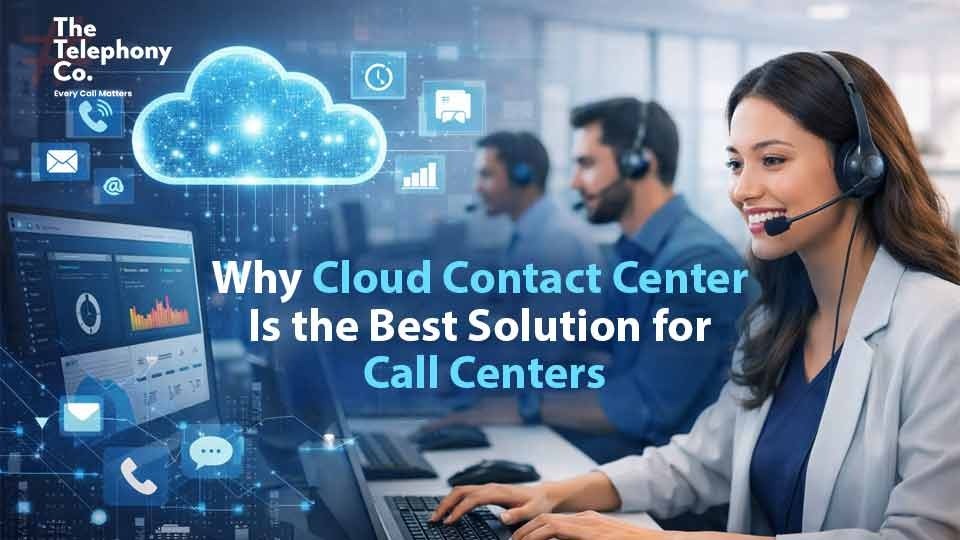
A Cloud Contact Center is a customer communication system that operates over the internet instead of using traditional on-site hardware and phone lines. It allows businesses to manage inbound and outbound calls, emails, live chat, SMS, and social media messages through a single online platform.
Unlike traditional call centers that require physical servers, PBX systems, and complex wiring, a cloud contact center is hosted on secure cloud servers. This means businesses can access the system from anywhere with an internet connection.
Why Cloud Based Contact Center Is the Best Solution for Call Centers
Here are the top reasons why inbound and outbound call center are switching to cloud-based contact center solutions.
1. Cost-Effective and Budget-Friendly
One of the biggest advantages of a cloud contact center is lower operational cost.
There is no need to invest in:
- Expensive PBX systems
- Physical servers
- Complex wiring infrastructure
Cloud solutions operate on a subscription-based model, meaning you only pay for what you use. This significantly reduces capital expenditure and allows businesses to manage budgets efficiently.
2. Easy Scalability
Business growth requires flexibility. With a cloud contact center, you can easily:
- Add or remove agents
- Increase call capacity
- Expand to new locations
All of this can be done without purchasing new hardware. Whether you are a startup or an enterprise, scalability becomes simple and fast.
3. Remote Work and Global Access
Modern businesses operate globally and remotely. A cloud contact center enables agents to work from anywhere with just an internet connection.
Benefits include:
- Work-from-home flexibility
- Access to global talent
- Business continuity during emergencies
- Reduced office infrastructure costs
This flexibility ensures uninterrupted customer service.
4. Advanced AI-Based Call Routing
Cloud contact centers use intelligent call routing systems. Calls are automatically directed to the most suitable agent based on:
- Skill set
- Availability
- Customer history
This reduces waiting time and improves first-call resolution rates.
AI-driven automation also helps in handling repetitive queries through IVR and chatbots.
 Also Read: What Is a Contact Center?
5. Real-Time Analytics and Reporting
Data is essential for business growth. A cloud contact center provides:
- Live call monitoring
- Agent performance tracking
- Call recording
- Customer interaction analytics
- Custom reports
- Call Tracking
Managers can identify performance gaps and improve service quality instantly.
6. Omnichannel Communication
Customers today communicate through multiple platforms. A omnichannel contact center integrates:
- Voice calls
- Emails
- Live chat
- SMS
- Social media
This unified communication system ensures consistent customer experience across all channels.
7. Improved Customer Experience
Customer satisfaction directly impacts business growth. Cloud contact centers improve customer experience by:
- Reducing call wait times
- Offering 24/7 support
- Providing faster query resolution
- Personalizing interactions
When customers receive quick and efficient support, they are more likely to stay loyal to your brand.
8. High-Level Security and Data Protection
Cloud contact centers are built with advanced security protocols such as:
- Data encryption
- Secure access controls
- Regular system updates
- Cloud backups
This ensures customer data remains protected and compliant with industry standards.
Traditional Call Center vs Cloud Contact Center
Here is a clear comparison to understand the difference:
| Feature | Traditional Call Center | Cloud Contact Center |
| Setup Cost | High upfront investment | Low subscription-based |
| Hardware Required | Yes | No |
| Maintenance | Manual & Expensive | Managed by Provider (The Telephony Co) |
| Scalability | Limited | Instant & Flexible |
| Remote Access | No | Yes |
| Analytics | Basic | Advanced Real-Time Reporting |
| Downtime Risk | High | Minimal |
| Omnichannel Support | Limited | Fully Integrated |
Key Takeaways
Traditional Call Center Are Expensive and Inflexible
Cloud Contact Center Reduce Costs and Increase Efficiency
Remote Work Becomes Seamless
AI Improves Call Routing and Automation
Real-time Analytics Drives Smarter Decisions
Customer Experience Significantly ImprovesHow a Cloud Contact Center Improves Inbound Call Center Performance
Intelligent Call Routing
Cloud contact centers use AI-based smart routing to connect callers to the most suitable agent based on skills, department, language, time or availability. This reduces call transfers and increases first-call resolution rates.
Advanced IVR System
Interactive Voice Response (IVR) systems guide customers to the correct department automatically. This reduces waiting time and improves call management efficiency.
Reduced Call Waiting Time
With automated queue management and real-time monitoring, businesses can handle high call volumes efficiently. Customers are informed about wait times, which improves transparency and reduces frustration.
Real-Time Monitoring and Analytics
Managers & Supervisors can monitor live inbound calls and track metrics such as:
- Average Handling Time
- Call Abandonment Rate
- Agent Performance
- Customer Satisfaction Trends
This data helps improve service quality and decision-making.
CRM Integration for Personalized Support
When a customer calls, agents can instantly access previous interaction history through CRM integration. This allows agents to provide faster and more personalized solutions.
Also Read: Best Contact Center Software Providers
How a Cloud Contact Center Improves Outbound Call Center Performance
Auto Dialer and Predictive Dialing
Cloud outbound call center software includes:
-
Auto dialer
-
Predictive dialer
These tools automatically dial numbers, reducing agent idle time and increasing call volume.
Campaign Management Tools
Businesses can create and manage structured outbound campaigns. Managers can track:
-
Call attempts
-
Conversion rates
-
Lead status
-
Agent performance
This improves campaign success rates.
Real-Time Performance Insights
Analytics dashboards help identify what scripts work best and which agents perform better, allowing data-driven improvements.
Call Recording for Training
Outbound calls can be recorded and reviewed to improve communication strategies and training programs.
Scalable Sales Operations
Need to expand your sales team? A cloud solution allows you to add new agents instantly without infrastructure upgrades.
Looking to Upgrade your Call Center?
Switch to The Telephony Co Echo Cloud Contact Center Solution and Transform your Customer Experience Today
Real-World Business Success with The Telephony Co Cloud Contact Center Software
Example 1: E-Commerce Company
A fast-growing e-commerce brand partnered with The Telephony Co after struggling with high missed call rates and increasing customer complaints during peak sale seasons.
By implementing The Telephony Co’s Cloud Contact Center solution, they:
-
Reduced missed calls by 80%
-
Improved response time by 90%
-
Increased overall customer satisfaction ratings
-
Managed high call volumes during festive sales smoothly
With smart IVR solution and intelligent call routing, customers were instantly connected to the right department, improving both efficiency and brand trust.
Example 2: Healthcare Support Center
A healthcare provider needed a reliable communication system to support remote agents during emergency situations. Their traditional setup limited flexibility and caused service disruptions.
After switching to The Telephony Co ECHO Cloud Contact Center, they:
-
Enabled remote agents within days
-
Ensured uninterrupted patient communication
-
Monitored calls in real-time for quality assurance
-
Improved response speed for urgent inquiries
The secure and scalable cloud infrastructure helped them maintain consistent service even during critical periods.
Example 3: Financial Services Firm
A financial services company was looking to improve first-call resolution and enhance customer service efficiency. They adopted The Telephony Co’s cloud solution with real-time analytics and CRM integration.
Within three months, they:
-
Improved first-call resolution by 28%
-
Reduced average handling time
-
Increased agent productivity
-
Gained actionable insights through live performance dashboards
With advanced reporting tools, management could quickly identify performance gaps and optimize team operations.
Final Thoughts
The business communication landscape is changing rapidly. Customers demand faster responses, personalized interactions, and seamless service across platforms.
Traditional call center systems can no longer meet these expectations efficiently.
A cloud contact center offers:
-
Cost Savings
-
Scalability
-
Flexibility
-
Advanced Analytics
-
Improved Customer Satisfaction
- Advanced Features (AI based automation & call routing, Omnichannel, Auto dialer, CRM integration and more)
For modern call centers aiming to grow and compete in today’s digital environment, switching to a cloud contact center is not just an upgrade — it is a strategic move.
Frequently Asked Questions
Is a cloud contact center secure?
Yes, most cloud contact center solutions use advanced encryption, secure servers, and compliance protocols to protect customer data.
Can small businesses use cloud contact center software?
Absolutely. Cloud solutions are scalable and affordable, making them ideal for startups, small businesses, and large enterprises.
How much does a cloud contact center cost?
Costs vary depending on features and usage, but cloud systems are generally more cost-effective than traditional setups due to their subscription-based pricing model.
Does a cloud contact center support remote agents?
Yes. Agents can work from anywhere using an internet connection, making remote work easy and efficient.