Businesses today are changing the way they talk to customers. Customers now expect quick replies, 24/7 support, and a better experience. To manage this, many businesses are using AI voice bots. These systems use technologies like Natural Language Processing (NLP) and text-to-speech to handle phone calls automatically. They can answer customer questions, route calls to the right department, book appointments, qualify leads, make outgoing calls, and manage IVR menus. Voice bots are helping businesses handle both inbound and outbound calls more easily and efficiently.
Many businesses want to know how voice bots can improve their customer communication. Let’s understand this technology and see how it makes business communication simpler. In this article, we will explain what voice bots are, how they work, their benefits, where they are used, and how to choose the right one for your business.
What Is an AI Voice Bot?
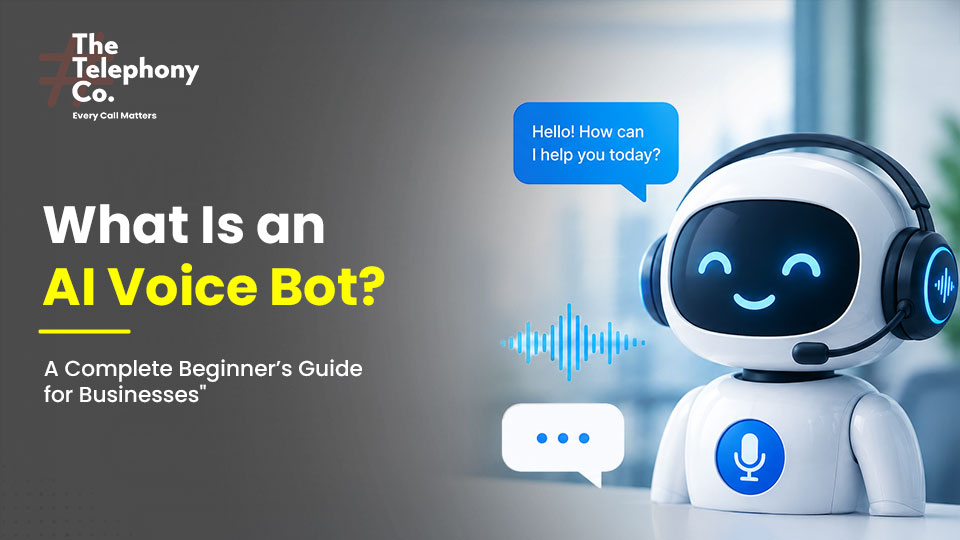
An AI voice bot is a software-based virtual assistant that communicates with people through voice conversations. It can answer incoming calls, understand customer questions, and provide human-like responses automatically.
Unlike IVR systems that only use fixed menu options like “Press 1 for sales,” AI voice bots can understand natural human speech and respond intelligently. These systems use NLP (Natural Language Processing) to analyze spoken language and provide accurate answers in real time. Some businesses use them to handle inbound calls. Others use them for outbound campaigns — like appointment reminders, payment follow-ups, or lead follow-through.
Power Your Business with Intelligent Voice Automation
 Scalable Customer Support
Multilingual communication
Faster Business Response Time
Scalable Customer Support
Multilingual communication
Faster Business Response TimePower Your Business with Intelligent Voice Automation
Scalable Customer Support
Multilingual Communication
Faster Business Response TimeHow Does an AI Voice Bot Work?
The caller speaks
A customer calls in or the bot initiates a call. The person speaks naturally, just like they would to a human.
Speech recognition kicks in
The bot captures the audio and converts the spoken words into text. This is called Automatic Speech Recognition (ASR).
The AI understands the intent
The text is processed by a Natural Language Processing (NLP) engine. This is where the AI figures out what the person actually wants — not just the words they used, but the meaning behind them.
The right response is generated
Based on the intent, the system either pulls from a pre-set response, fetches data from a connected system (like a CRM or booking tool), or escalates to a human agent if needed.
The bot responds with voice
Using Text-to-Speech (TTS) technology, the response is converted back into natural-sounding speech and delivered to the caller.
Industries That Can Benefit from AI Voice Bots
Healthcare
- Handle appointment bookings automatically
- Send appointment and medicine reminders
- Answer common patient questions
- Collect basic patient information before consultation
- Reduce waiting time for patients
- Allow staff to focus on critical tasks
E-commerce
- Share order and delivery updates
- Handle return and refund requests
- Answer product and payment-related questions
- Support customers during peak sales periods
- Reduce customer waiting time
- Improve overall shopping experience
Banking & Finance
- Provide account balance information
- Send transaction and fraud alerts
- Handle basic customer inquiries
- Help customers with card-related support
- Reduce pressure on support teams
- Offer faster customer service 24/7
Customer Support
- Handle frequently asked questions
- Route calls to the correct department
- Reduce customer waiting time
- Provide support 24/7
- Manage large call volumes efficiently
- Improve customer satisfaction
Travel & Hospitality
- Confirm bookings automatically
- Share travel and itinerary updates
- Send check-in and check-out reminders
- Handle cancellations and rescheduling
- Support customers during busy travel seasons
- Improve guest experience with faster responses
AI Voice Bot vs Human Agent vs Traditional IVR
Here’s a simple comparison table to clearly understand the difference:
| Feature | AI Voice Bot | Human Agent | IVR System |
| Response Speed | Instant | Depends on availability | Instant (but limited) |
| Availability | 24/7, no breaks | Business hours only | 24/7 Available |
| Cost | Low (after setup) | High (salary, training) | Low (but rigid) |
| Personalization | Moderate to High | High | Very Low |
| Multilingual Support | Yes (multiple languages) | Limited by staff | Rarely |
| Scalability | Handles thousands simultaneously | Limited by headcount | Limited by menu design |
Benefits of Using AI Voice Agents
24/7 Availability — Your business never sleeps when a voice bot is running. Customers can get help at midnight, on weekends, or during holidays — without adding to your payroll.
Faster Response Time — No hold music. No queue. The bot answers immediately, which keeps customers happy and reduces drop-off rates.
Reduced Operational Cost — Handling thousands of calls that would otherwise require a large support team becomes much more affordable. Most businesses see significant cost savings within the first few months.
Better Customer Experience — When customers get quick, accurate answers without being bounced around, their satisfaction goes up. A good voice bot feels helpful, not robotic.
Call Handling Automation — Repetitive tasks like order confirmations, appointment reminders, and FAQ responses can be fully automated — freeing your team for meaningful work.
Lead Qualification — Voice bots can engage new leads the moment they reach out, ask the right questions, and pass only the qualified ones to your sales team.
How to Choose the Right AI Voice Bot for Your Business
Easy Integration — Smoothly integrate with existing tools like your CRM, helpdesk, calendar, or e-commerce platform.
Language Support — If your customers speak multiple languages or regional dialects, make sure the bot can handle that. Good language support is especially important for businesses serving diverse markets.
CRM Compatibility — A voice bot that syncs with your CRM can pull customer history, personalize conversations, and log call data automatically — making every interaction smarter.
Custom Workflows — Your business has specific needs. The bot should be flexible enough to follow your processes, not force you to change how you work.
Analytics & Reporting — You need visibility into what’s working. Look for a platform that gives you call summaries, drop-off points, resolution rates, and customer sentiment data.
Security & Compliance — Especially for healthcare, finance, or any business handling personal data — make sure the platform follows the necessary security standards and data privacy regulations.
Scalability — Choose a solution that grows with you. What works for 100 calls today should still work when you’re handling 10,000.
Conclusion
AI voice bots are changing the way businesses talk to their customers — and that shift is only going to accelerate. They’re not just a tech upgrade. They’re a smarter, more efficient way to deliver great service at scale, without burning out your team or inflating your costs.
If you’re a business owner who’s still relying entirely on human agents or a clunky IVR menu to handle customer calls, now is a good time to explore what voice bots can do for you. The technology has matured, the costs have come down, and the results speak for themselves.
The businesses winning at customer experience today are the ones investing in the right tools — and an AI voice bot might just be one of the most impactful ones you can add.