
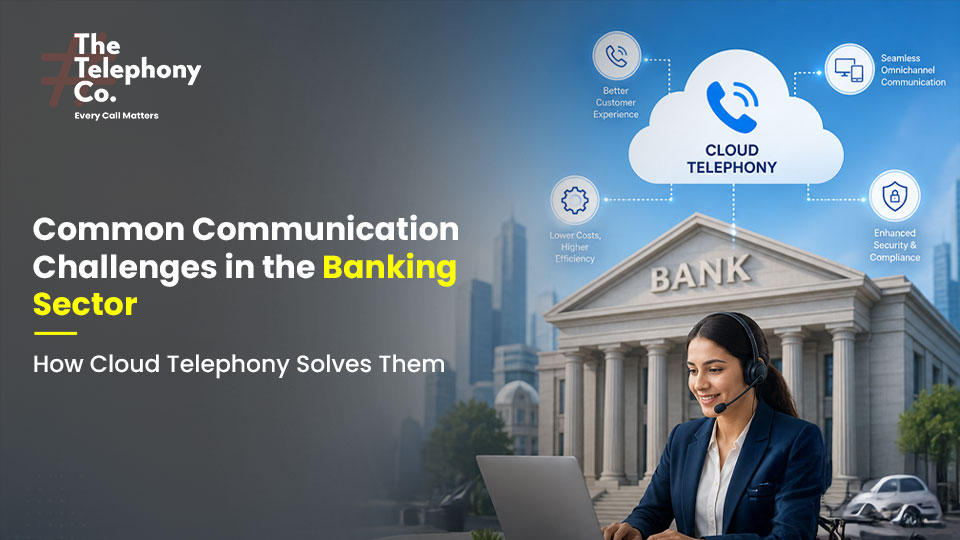
The banking sector is a very large industry that deals with a huge number of customers every day. However, many banks still rely on old phone systems, which create several communication problems.
Banks often face challenges such as high call volumes, delays, and outdated systems. These issues not only affect customer experience but also reduce overall efficiency.
When a customer calls a bank, they expect their problem to be solved quickly. But in reality, they often face long waiting times, call drops, incorrect call routing, or are asked to call back later. This leads to frustration and can result in negative reviews.
Cloud telephony can solve these communication challenges quickly. It helps banks manage customer interactions more efficiently, reduce response time, and deliver a better customer experience without depending on complex hardware systems.
Understanding Communication in the Banking Sector
Communication is the backbone of the banking industry. From customer support calls to transaction alerts and loan inquiries, banks handle thousands—sometimes millions—of interactions daily.
Traditionally, banks relied on on-premise systems like PBX (Private Branch Exchange), landlines, and basic call centers. While these systems worked in the past, they struggle to meet modern demands such as:
- 24/7 customer availability
- Faster response times
- Personalized communication
- Secure data handling
With digital banking on the rise, communication systems must evolve to match customer expectations.
Deliver Seamless Banking Communication Across Every Customer Touchpoint Today
 Instant Query Resolution
Unified Communication Channels
Consistent Customer Experience
Instant Query Resolution
Unified Communication Channels
Consistent Customer ExperienceModernize Your Business Communication with Reliable SIP Trunking Solutions
Instant Query Resolution
Unified Communication Channels
Consistent Customer ExperienceCommon Communication Challenges in the Banking Sector
High Call Volume and Long Wait Times
Banks handle a large number of inbound calls every day. During peak times—such as salary credit days, festive seasons, IPO launches, or interest rate announcements—the call volume increases significantly.
However, traditional phone systems often cannot handle high call volume. As a result, customers who call the bank have to wait for a long time before they can speak with an agent.
Inefficient Call Routing
Many banks still use old and outdated traditional phone systems. These systems lack proper call routing, which means calls often do not reach the right agent or department.
As a result, both customers and bank staff waste time, leading to frustration and poor service experiences.
Lack of Personalization
Whenever a customer calls the bank using their registered phone number, the bank should be able to who the customer is.
If an agent answers the call without having any information about the customer, the customer has to explain everything from the beginning. This increases the average handling time.
Lack of Multi Language Support
In many banking services, customers are usually given the option to communicate only in Hindi or English. However, if a customer prefers to speak in any other language, the system often does not support it, leading to communication gaps and a poor customer experience.
Security & Compliance Issues
Banking calls carry some of the most sensitive data in any industry — account numbers, OTPs, personal identification details, and financial disclosures. Regulators including RBI, TRAI, and international bodies under GDPR impose strict requirements around call recording, data retention, and DNCR (Do Not Call Registry) compliance. Legacy systems often lack built-in mechanisms to meet these standards, creating legal risk and reputational exposure for banks that fall short.
No Real-time Monitoring & Analytics
Traditional phone systems were limited to just making and receiving calls. They did not offer any monitoring or analytics features.
Managers using these outdated systems often operate without visibility. There is no live dashboard to track which agents are on calls, current wait times, or how many calls have been abandoned in the last hour.
Is there a solution to communication challenges in banking? Yes—cloud telephony is the answer.
Cloud telephony, also called hosted VoIP or cloud calling, is a communication solution where voice calls are managed and delivered over the internet rather than through traditional copper-wire telephone lines. Instead of housing hardware on-site, the entire telephony infrastructure — servers, switching, intelligent call routing, and call recording — is maintained by a cloud service provider.
For banks, this means agents can make and receive calls from any internet-connected device, anywhere. Numbers, IVR menus, call queues, and recording policies are all configured through an online dashboard. There is no physical hardware to install, and capacity can be scaled up or down in minutes rather than weeks.
Cloud telephony platforms also integrate natively with CRM systems, compliance tools, and analytics dashboards — making them a far more capable foundation for modern banking communication than any legacy system.
How Cloud Telephony Solves Banking Communication Challenges
AI-Based Call Routing
Cloud telephony uses intelligent routing logic — based on caller ID, time of day, department, language, and agent skill — to connect every customer to exactly the right agent on the first attempt.
AI Chatbots & Virtual Assistants
AI chatbots and virtual assistants help banks handle customer queries quickly and efficiently across multiple channels like chat, WhatsApp, and websites. They can understand common questions and provide instant responses without human involvement.
- 24/7 automated support – Customers can get help anytime, even outside business hours
- Handles FAQs, balance checks, and basic requests – Quickly resolves common queries without waiting for an agent
- Reduces workload on human agents – Frees up agents to focus on complex or high-priority issues
IVR (Interactive Voice Response)
Modern IVR systems are now enhanced with AI capabilities. IVR helps route customers to the right department through pre-recorded menu options.
Check account balance: Customers can use IVR self-service to check their account balance on their own.
Get transaction details: They can also access their monthly transaction details without needing help from an agent.
A modern IVR system allows customers to handle basic queries through self-service, so they can get the information they need without speaking to an agent.
Real-Time Analytics and Reporting
Cloud-based systems provide businesses with detailed call reports. Live dashboards give managers real-time visibility into call queues, agent availability, wait times, and call abandonment rates.
- Call Volume: Shows the total number of incoming and outgoing calls during a specific time period.
- Call Queues: Displays how many calls are currently waiting in the queue.
- Agent Availability: Shows which agents are available, busy, or offline in real time.
- Agent Performance: Tracks key metrics like call handling time, number of calls handled, and overall efficiency.
- Abandonment Rates: Indicates how many callers disconnected before speaking to an agent.
- Wait Times: Shows the average time customers spend waiting before their call is answered.
CRM Integration & Personalization
Cloud telephony integrates with existing banking systems and brings all customer data into one place. When a customer calls, the agent can instantly view the customer’s complete account history on their screen. This helps agents understand the customer’s issue quickly, provide personalized support, and resolve queries faster without asking customers to repeat their information.
Omnichannel Communication
Omnichannel communication means connecting with customers across multiple channels—like calls, SMS, email, WhatsApp, and chat—while providing a smooth and consistent experience on every platform.
Instead of handling each channel separately, all customer interactions are connected in one system. This allows businesses, especially banks, to manage conversations more efficiently and avoid confusion.
Data Security & Compliance
Enterprise-grade cloud telephony platforms include end-to-end encryption, role-based access controls, automated call recording with configurable retention policies, and built-in DNCR filtering. This makes it significantly easier for banks to demonstrate compliance with RBI guidelines, TRAI regulations, and data privacy requirements — reducing legal risk and audit overhead simultaneously
Remote Accessibility
Cloud telephony liberates agents from the physical branch. Whether working from a central call center, a remote office, or home, every agent has access to the same tools, queues, and dashboards. This enables banks to build flexible, resilient workforce models — a capability that proved critical during the pandemic and remains strategically valuable today.
Real-World Use Cases in Banking
Cloud telephony is already powering some of the most critical banking workflows:
- Loan inquiry handling: Auto-dialers and click-to-call features allow loan officers to follow up efficiently with applicants, dramatically improving conversion rates on inbound leads.
- Fraud alert communication: Banks use cloud telephony to trigger instant outbound calls or SMS alerts the moment suspicious activity is detected — reaching customers faster than any traditional system.
- Customer onboarding & KYC: Verification calls during KYC are recorded, timestamped, and stored compliantly — meeting regulatory requirements while improving the customer onboarding experience.
- OTP & transactional alerts: High-volume, time-sensitive transactional messages are delivered reliably through cloud infrastructure, with delivery tracking and fallback logic built in.
- Collections & recovery: Automated follow-up sequences for loan EMI reminders reduce manual effort while maintaining a compliant, auditable communication trail.
The Telephony Co. — Built for Banking-Grade Communication
- Global VoIP number support: Get local and international virtual numbers to expand reach and serve customers across different regions easily.
- Advanced IVR systems: Automate call handling with smart menus, reducing workload on agents and improving customer experience with faster responses.
- Secure and compliant infrastructure: Ensure data protection with encryption and meet industry regulations for safe and reliable communication systems.
- Easy integration with existing tools: Seamlessly connect with CRM and banking systems to improve workflow, data access, and overall efficiency.
- 24/7 customer support: Round the clock assistance ensures quick issue resolution and uninterrupted communication for better service reliability.
The Telephony Co. is one such provider that helps businesses modernize their communication systems with scalable and secure cloud telephony solutions. With features like virtual numbers, call routing, and real-time analytics, it enables banks to deliver seamless customer experiences.
Upgrade Your Banking Communication with Smart
Cloud Telephony Solutions
Conclusion
Communication plays a critical role in the banking sector. However, traditional systems often fail to meet modern demands, leading to delays, inefficiencies, and poor customer experiences.
Cloud telephony addresses these challenges by offering a flexible, scalable, and cost-effective solution. From smart call routing to real-time analytics and enhanced security, it transforms the way banks interact with their customers.
As the banking industry continues to evolve, adopting cloud telephony is no longer an option—it’s a necessity for delivering better service and staying ahead in a competitive market.