When we talk about customer support, it is not an easy job. Agents deal with many customers every day who may be frustrated, ask complex questions, or create high-pressure situations. When a new agent struggles to answer a customer on a call, the situation can quickly escalate.
This happens very often in call centers. In such cases, agents may feel stuck, and supervisors or managers sometimes cannot step in at the right moment. They can only watch the situation and feel helpless, even when they want to help.
This is where call barging becomes useful. It allows supervisors or managers to join a live call instantly and support the agent in real time. The best part is that they can enter the call without putting it on hold, disconnecting it, or asking the customer to wait for a callback. This ensures that the agent does not feel alone and the customer gets immediate assistance.
In this guide, we will explain what call barging is, how it works, and why every customer support team should understand and use it.
What is Call Barging?
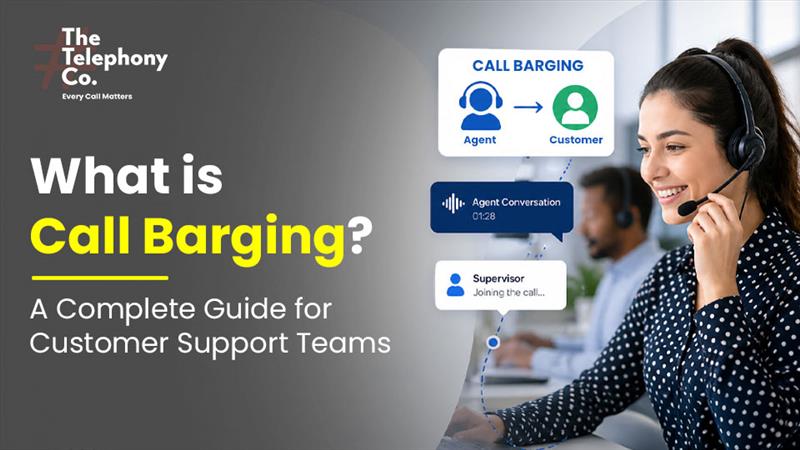
Call Barging is a feature of call center that allows a team leader or manager to enter a live call while the agent and customer are talking, without cutting, holding, or transferring the call. It is a three-way calling solution where the agent, customer, and team leader are all on the same call.
In call monitoring, the supervisor can only listen to the call during the call or hear the call recording after the call ends. But in Call Barging, the supervisor can add themselves to the call without any permission.
It’s widely used in call centers, customer support teams, and sales departments to:
- Protect the customer experience during difficult calls
- Train agents on the job
- Resolve escalated issues faster
- Reduce average handling time (AHT)
Most modern VoIP phone systems and cloud call center platforms come with call barging built in — often alongside call monitoring and call whispering.
Modernize Your Business Communication with Reliable
SIP Trunking Solutions
 Reduce Communication Costs
Scale as Your Business Grows
High-Quality Voice Connectivity
Reduce Communication Costs
Scale as Your Business Grows
High-Quality Voice ConnectivityModernize Your Business Communication with Reliable SIP Trunking Solutions
Reduce Communication Costs
Scale as Your Business Grows
High-Quality Voice ConnectivityHow Call Barging Works
Step-by-Step Process
Here’s how a typical call barging situation looks in a real call center:
Step 1 — Customer Calls the Company: A customer dials the company support virtual phone number and gets connected to a live agent. The conversation begins.
Step 2 — Supervisor Monitors the Call The supervisor uses the call monitoring dashboard to listen in silently. The agent and customer don’t know the supervisor is listening.
Step 3 — Supervisor Decides to Barge In If the call is going poorly — maybe the agent is giving wrong information, or the customer is getting upset — the supervisor clicks the “barge” option.
Step 4 — Supervisor Joins the Live Call Now all three people are on the call. The supervisor can speak directly to the customer, correct a mistake, or take over the call entirely.
Step 5 — Issue Gets Resolved The problem is handled quickly. The customer gets a better experience. The agent learns from the interaction.
Types of Call Monitoring
Call barging is part of a family of call center features used for oversight and coaching. Let’s look at all three:
Call Listening (Silent Monitoring)
This is when a supervisor listens to a live call without anyone knowing. They can’t speak — they just observe. It’s great for quality checks and understanding how agents perform naturally.
Call Whispering
With call whispering, the supervisor can speak to the agent during the call — but the customer cannot hear them. It’s like a coach giving quiet tips from the sidelines. The agent gets guidance without the customer even knowing.
Call Barging
A supervisor can join the live call between the agent and the customer and quickly solve difficult problems without putting the call on hold, using third-party transfers, or causing long wait times.
Why Customer Support Teams Need Call Barging Software
Still wondering if call barging is right for your team? Here are five practical reasons it matters:
Faster problem resolution — Instead of putting a customer on hold and calling back, a supervisor can fix the issue in real time.
Better agent training — New agents learn faster when they experience real-call coaching, not just classroom training.
Reduced escalations — Many calls that would become complaints can be saved if a supervisor steps in early.
Consistency in service quality — Supervisors can catch errors and ensure agents are following the right process.
Customer satisfaction — When customers get fast, accurate help, they leave the call feeling valued — not frustrated.
Key Benefits of Call Barging
Here’s a quick summary of why call barging is worth using:
Real-time support — Help agents exactly when they need it, not after the call ends
Reduced training time — Agents learn faster through live call experience
Better first-call resolution — Issues get solved in one call, not two or three
Improved customer experience — Customers feel heard and helped
Quality assurance — Supervisors can catch issues as they happen, not during audits
Agent confidence — Knowing backup is available reduces stress and improves performance
Call Barging vs Call Whispering vs Call Monitoring
| Feature | Who Can Hear | Who Can Speak | Best Use Case |
| Call Monitoring | Supervisor only | No one (supervisor listens only | Silent quality checks |
| Call Whispering | Supervisor only + Agent | Supervisor speaks to agent only | Live agent coaching |
| Call Barging | All three parties | Everyone can speak | Emergency intervention |
Use monitoring for everyday quality checks. Use whispering for coaching. Use barging when a call is about to go wrong.
Best Practices for Using Call Barge
Call barging is powerful — but it should be used thoughtfully. Here are a few best practices:
Use it only when necessary — Don’t barge into every call. Reserve it for situations that truly need intervention.
Introduce yourself when joining — Let the customer know a supervisor has joined. It builds trust and avoids confusion.
Brief your agents in advance — Agents should know that call barging is part of your quality process so they don’t feel blindsided.
Follow up after the call — Use the barge as a coaching moment. Discuss what happened and how the agent can improve.
Respect privacy and compliance — Make sure your team follows local laws around call recording and disclosure.
Features to Look for in Call Barging Software
Not all call center software is built the same. Here’s what to look for:
One-click barging — The supervisor should be able to join a call quickly without complicated steps
Live call dashboard — A clear view of all active calls so supervisors know where to focus
Call recording — The ability to record and review calls for training and compliance
Call whispering included — Look for platforms that offer all three monitoring modes
Easy integration — The software should connect smoothly with your existing CRM or business phone system
How The Telephony Co Helps You
If you’re looking for a platform that makes call barging simple and effective, The Telephony Co is built with customer support teams in mind.
Here’s what you get:
- Real-time call monitoring — Watch all your live calls from a single, clean dashboard
- Call barging and whispering — Step in silently or fully join any call with one click
- Easy-to-use interface — No complicated setup. Your team can get started quickly
- 24/7 support — Whenever you need help, we’re available around the clock
Whether you run a small support team or a large call center, The Telephony Co gives you the tools to deliver a better customer experience every single day.
Conclusion
Customer support is all about making people feel heard and helped. Call barging is one of the simplest ways to make sure that happens — even when things get tough.
It gives supervisors the power to step in at the right moment, guide their agents, and protect the customer experience in real time. Combined with call monitoring and call whispering, it forms a complete coaching toolkit for any modern support team.
If you haven’t explored call barging yet, now is a great time to start. Take a look at what your current phone system offers — and if it’s not enough, consider switching to a platform built for teams like yours.