
The way businesses communicate has changed dramatically over the past decade. Traditional copper-wire telephone networks — once the backbone of every office — are steadily giving way to flexible, internet-powered alternatives that offer far more value for money and far fewer limitations.
For decades, companies relied on the Public Switched Telephone Network (PSTN) to manage their voice calls. While the PSTN served its purpose well, it was expensive to maintain, difficult to scale, and offered little room for integration with modern software tools. Businesses had to pay for fixed physical lines regardless of how much they actually used them, and expanding capacity meant ordering new hardware and waiting for engineers to install it.
Today, forward-thinking organisations are moving to internet-based communication solutions — and SIP trunking sits right at the heart of that shift. Whether you run a growing startup, a mid-sized enterprise, or a large corporation with multiple locations, SIP trunking gives you the power to reduce telephony costs, scale your phone system on demand, and connect your on-premises PBX system to the broader digital world.
This article explains exactly what SIP trunking is, how it works, why it matters for your business, and how to get started.
What is SIP Trunking?
SIP trunking (Session Initiation Protocol) allows businesses to make and receive calls over the internet instead of traditional PSTN phone lines. The term “trunk” originates from telephony, where it described a bundle of channels connecting a business phone system to the telephone network — SIP replicates this digitally using virtual channels over your existing internet connection.
SIP trunking connects your on-premises PBX system to a provider, which routes calls to the PSTN or other internet-based systems — giving your business worldwide calling capability without costly physical infrastructure. SIP itself is the signalling protocol that initiates, manages, and terminates every voice, video, and messaging session.
Modernize Your Business Communication with Reliable
SIP Trunking Solutions
 Reduce Communication Costs
Scale as Your Business Grows
High-Quality Voice Connectivity
Reduce Communication Costs
Scale as Your Business Grows
High-Quality Voice ConnectivityModernize Your Business Communication with Reliable SIP Trunking Solutions
Reduce Communication Costs
Scale as Your Business Grows
High-Quality Voice ConnectivityHow Does SIP Trunking Work?
SIP trunking converts voice into data packets and transmits them over an IP network.
Call Initiated — User dials from a handset or softphone; the PBX begins setup via SIP.
SIP INVITE Sent — PBX sends a SIP INVITE to the provider with caller details and preferred audio codec.
Call Routed — Provider routes the call to a VoIP endpoint or through a gateway to the PSTN.
Connection Confirmed — SIP messages (100 Trying → 180 Ringing → 200 OK) establish the session.
Voice Transmitted — Audio travels in real-time packets via RTP, reassembled at the destination.
Call Managed — SIP handles hold, transfer, and conferencing throughout the session.
Call Ended — A SIP BYE message terminates the session and frees the channel.
The entire process completes in milliseconds.
Benefits of SIP Trunking
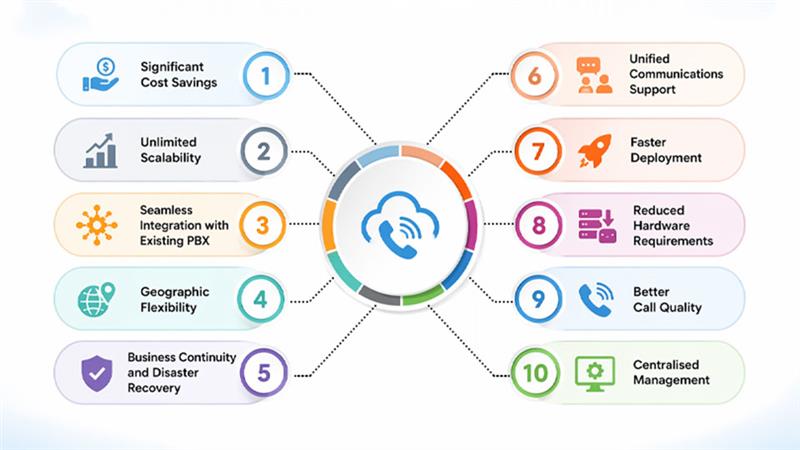
Significant Cost Savings
SIP trunking eliminates the need for expensive traditional phone lines and PSTN connections. Businesses typically see reductions of 40–60% on monthly telephony costs, with lower per-minute rates for local, national, and international calls.
Unlimited Scalability
Adding or removing SIP channels takes minutes, not days. Whether your business is growing rapidly or adjusting seasonally, you can scale your business phone system up or down without ordering new hardware or waiting for physical installations.
Seamless Integration with Existing PBX
SIP trunks connect directly to your existing on-premises PBX system or IP PBX system, meaning you do not need to replace your entire phone infrastructure. You get modern capabilities while preserving your current investment.
Geographic Flexibility
Employees can make and receive calls from anywhere with an internet connection. SIP trunking supports remote workers and multi-site operations effortlessly, keeping your team connected regardless of physical location.
Business Continuity and Disaster Recovery
If your office loses power or internet, calls can be automatically rerouted to mobile numbers or alternative sites. SIP trunking builds resilience directly into your business phone system, minimising downtime during unexpected events.
Unified Communications Support
SIP trunking lays the foundation for unified communications — combining voice, video, instant messaging, and conferencing into a single platform. This streamlines workflows and improves collaboration across teams and departments.
Faster Deployment
Setting up SIP trunks is significantly faster than installing traditional PSTN lines. A new SIP trunk can often be provisioned and active within hours, helping businesses respond quickly to changing communication needs.
Reduced Hardware Requirements
Because SIP trunking is software-driven, it reduces the need for bulky physical hardware. Businesses can run softphones on computers or mobile devices, cutting equipment costs and simplifying IT management considerably.
Better Call Quality
Modern SIP trunk providers offer HD voice codecs and Quality of Service (QoS) controls, delivering clearer, more reliable calls than many traditional PSTN connections — especially on long-distance and international routes.
Centralised Management
Administrators can manage all SIP trunks, call routing rules, and user extensions from a single web-based portal, making it easy to monitor usage, generate reports, and make changes without specialised technical knowledge.
PRI vs SIP Trunking vs VoIP
These three terms are often used interchangeably, but they refer to distinct technologies. Here is a clear breakdown:
PRI (Primary Rate Interface) is a physical, circuit-switched connection delivered over T1 or E1 lines. It provides a fixed number of dedicated voice channels and connects an on-premises PBX system directly to the PSTN. It requires specialist hardware and installation, and its costs are largely fixed regardless of actual usage.
SIP Trunking is a virtual telephone trunk delivered over an IP network. It uses the Session Initiation Protocol to connect a PBX — either on-premises or hosted — to the PSTN or other VoIP endpoints. It is flexible, scalable, and cost-efficient, and it builds on existing internet infrastructure.
VoIP (Voice over Internet Protocol) is the broader umbrella technology that describes any voice communication transmitted over IP networks. SIP trunking is one implementation of VoIP, but VoIP also includes consumer services like WhatsApp calling, Zoom, and hosted phone services that do not require a PBX at all.
| Feature | PRI | SIP Trunking | VoIP |
| Infrastructure | Physical T1/E1 lines | Internet connection | Internet connection |
| Scalability | Fixed (23/30 channels) | Flexible, on-demand | Highly flexible |
| Cost (Setup) | High | Low to medium | Low |
| Cost (Monthly) | High (fixed) | Pay-as-you-use | Variable |
| PBX Required | Yes | Yes (IP or legacy) | Not always |
| Remote Working | Limited | Excellent | Excellent |
| Call Quality | Very consistent | Excellent (with QoS) | Variable |
| Disaster Recovery | Limited | Strong (auto-failover) | Strong |
| PSTN Access | Direct | Via SIP provider | Via provider/gateway |
| Contract Flexibility | Rigid | Flexible | Flexible |
For businesses currently operating on PRI who want greater flexibility and lower costs, SIP trunking is the natural upgrade path. For organisations starting fresh with no legacy infrastructure, a full hosted VoIP or UCaaS solution may offer even greater simplicity.
Features of SIP Trunking
Direct Inward Dialling (DID)
SIP trunking supports Direct Inward Dialling, allowing businesses to assign individual phone numbers to specific extensions or employees without requiring a separate physical line for each number, significantly reducing hardware costs.
Number Portability
Businesses can retain their existing phone numbers when switching to SIP trunking. Local, national, and international numbers can be ported to a SIP provider, ensuring customers always reach you on the same familiar number without disruption.
Multiple Concurrent Calls
A single SIP trunk can carry multiple simultaneous voice sessions. Businesses can purchase precisely the number of concurrent channels they need, expanding capacity instantly during busy periods without any physical infrastructure changes.
Failover and Redundancy
SIP trunking providers offer automatic failover routing, redirecting calls to backup numbers or alternative sites if the primary connection fails. This built-in redundancy keeps your business phone system operational during outages or network issues.
Codec Flexibility
SIP trunking supports a wide range of audio codecs, including G.711 for standard quality and G.722 for HD voice. Administrators can select the best codec for their bandwidth availability and call quality requirements across different locations.
Caller ID and CNAM
SIP trunking fully supports Caller ID and Caller Name (CNAM) services. Businesses can display their company name and chosen number when making outbound calls, reinforcing brand identity and improving call answer rates from customers.
Call Analytics and Reporting
Most SIP trunk providers include detailed call analytics dashboards, providing insights into call volumes, duration, peak hours, and missed calls. This data helps businesses optimise staffing, identify trends, and improve customer service performance.
Emergency Services (E911) Support
Reputable SIP trunking providers support Enhanced 911 (E911) services, ensuring that emergency calls are correctly routed to the nearest emergency services centre along with accurate caller location information, meeting regulatory compliance requirements.
T.38 Fax Support
For businesses that still rely on fax communication, SIP trunking can support T.38, a protocol that transmits fax data reliably over IP networks, allowing traditional fax machines and software to operate over a SIP trunk connection.
Integration with UCaaS Platforms
SIP trunks integrate seamlessly with Unified Communications as a Service (UCaaS) platforms, CRM systems, and helpdesk tools, enabling businesses to log calls automatically, trigger workflows, and deliver a richer customer experience.
Challenges and Considerations of SIP Trunking
While SIP trunking offers compelling advantages, businesses should be aware of several challenges before making the switch.
Internet Bandwidth Dependency
SIP trunking relies entirely on your internet connection. Each concurrent call consumes a portion of your bandwidth. Insufficient bandwidth leads to dropped calls, latency, or poor audio quality. Businesses must assess and potentially upgrade their internet service before deploying SIP trunks at scale.
Network Configuration Complexity
Deploying SIP trunking correctly requires careful network configuration, including firewall rules, Network Address Translation (NAT) traversal settings, and Quality of Service (QoS) policies. Incorrect configuration is a common cause of call quality issues and failed connections.
Security Vulnerabilities
SIP trunking can be susceptible to toll fraud, eavesdropping, and denial-of-service attacks if not properly secured. Businesses must implement robust security measures including encryption (TLS/SRTP), strong authentication, and regular monitoring to protect their communications.
Emergency Call Complications
Unlike traditional PSTN lines that automatically carry location data to emergency services, SIP trunking requires additional configuration to support accurate E911 services. Businesses must work with their provider to ensure compliant emergency call routing is in place.
PBX Compatibility
Not all legacy PBX systems are natively compatible with SIP trunking. Some older on-premises PBX systems require an additional gateway or adapter to connect to a SIP trunk, adding cost and complexity to the deployment process.
Provider Reliability Variance
The quality and reliability of SIP trunking services vary significantly between providers. Businesses should carefully evaluate uptime guarantees, SLA terms, customer support responsiveness, and network redundancy before committing to a SIP trunk provider.
Simplify and Optimize Your Business Calls with Cloud-Based SIP Trunking Solutions
Move Your Business to the Cloud with The Telephony Co SIP Trunking Service
Making the transition from traditional PSTN lines or ageing PRI circuits to a modern, cloud-ready communication system does not need to be complicated. The Telephony Co provides a fully managed SIP trunking service that helps businesses move smoothly to cloud-based communications.
With this platform, you can connect your existing on-premises PBX system or switch to a hosted IP PBX and start benefiting from internet-based voice communication. There is no need for a complete infrastructure overhaul, as the SIP trunks integrate seamlessly with your current setup, protecting your investment.
Reliability is a key strength, supported by a redundant, geo-distributed network that ensures high uptime. Automatic failover keeps your communication running without interruption.
The service also offers clear cost advantages with competitive pricing, no hidden charges, and flexible scaling options, allowing businesses to manage expenses efficiently.
Scalability is simple, enabling you to increase or decrease channels quickly through a self-service portal.
Additional features include HD audio, Direct Inward Dialling, number porting, E911 compliance, and integration with UCaaS and CRM tools, along with detailed call analytics.
Security is maintained through TLS and SRTP encryption, backed by reliable technical support.