
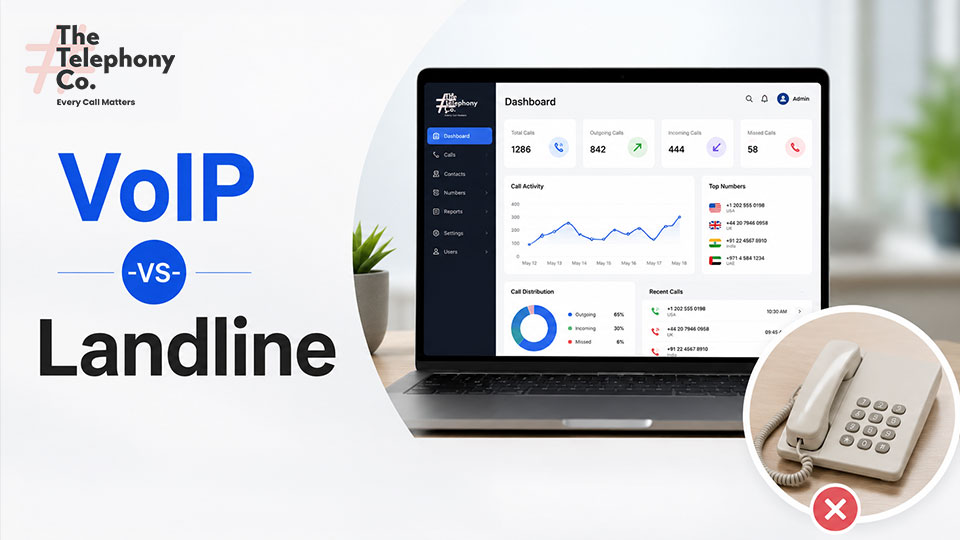
If you had to choose between VoIP vs Landline Phone for your business today, what would you choose? Most likely, your answer would be — VoIP.
With time, both technology and communication have changed a lot. Earlier, companies used traditional phone systems or desk phones for business communication. But with modern communication solutions, businesses are now slowly moving from landline phones to VoIP phone systems.
Today’s businesses need a phone system that has advanced features, works reliably, and can easily handle increasing call volumes. VoIP (Voice over Internet Protocol) works through the internet and gives businesses flexibility along with smart communication features. On the other hand, traditional landline phone systems depend on copper wire infrastructure. The main job of both systems is to make and receive calls, but when we compare them, we can clearly see many differences in their features, working style, and performance.
Landline phones have been the backbone of business communication for 7 to 8 decades and have fulfilled companies’ phone communication needs. But in today’s digital world, VoIP has become an attractive choice for businesses because of its flexibility, scalability, and advanced features.
After reading this article, you will easily understand the difference between VoIP vs Landline Phones, their features, advantages, and disadvantages, and which phone system can give better performance and long-term value for your business.
What is VoIP?
VoIP (Voice over Internet Protocol), also known as a hosted phone service, is a type of telephony technology that uses an internet connection to make and receive calls. It is one of the fastest communication methods for businesses, providing clear call quality with zero background noise. With its advanced features and call quality, VoIP has become a cost-effective and reliable solution for both personal and business communication.
How Does VoIP Phone System Work?
Voice over Internet Protocol, also known as VoIP, works by converting your voice into digital signals or data packets when you make a call. These data packets are sent through the internet to the VoIP service provider. After that, the VoIP provider routes the call to the Public Switched Telephone Network (PSTN).
This whole process within a few milliseconds, allowing the VoIP call to connect smoothly. Fast and stable Fiber Broadband Internet Connections (FBIC) make this communication possible.
Upgrade Outdated Phone Systems with Modern VoIP Business Solutions Today
 Better Flexibility and Scalability
Crystal Clear Voice Quality
Reduced Maintenance Costs
Better Flexibility and Scalability
Crystal Clear Voice Quality
Reduced Maintenance CostsUpgrade Outdated Phone Systems with Modern VoIP Business Solutions Today
Better Flexibility and Scalability
Crystal Clear Voice Quality
Reduced Maintenance CostsWhat is Landline Phone?
Landline Phone (traditional phone system) is a stable wired phone system that stays in one place and uses copper wires or telephony lines to make and receive calls.
What is Landline Phone?
Landline phones are wired phone systems installed by local telecom companies. These phone systems are also known as traditional phone systems or Plain Old Telephone Service (POTS).
Landline systems use copper wires to make and receive calls. Voice is transmitted through the wires using electrical pulses. These wires are installed by telecom service providers and are connected to a telephone exchange, which is linked to the companies that provide landline phone services.
VoIP vs Landline Pone: Which Phone System Is Better for Businesses?
When we talk about both types of phone systems, the main purpose of both is to help people communicate through phone calls. But there is a big difference between them — the method of communication and the level of flexibility available.
Landline phone systems work through wires and need a separate telephony network. On the other hand, VoIP services work through the internet (Wi-Fi). Both systems need different types of network services.
VoIP is an advanced technology that can integrate with different software and apps and provide advanced features. In comparison, landline service is mainly limited to making and receiving calls.
These are some important points that explain the key differences between the two systems.
Cost
If you are thinking about choosing a landline phone system for your business, it can be expensive because you may need to spend more money on setup and maintenance. It requires multiple phone systems, wires, routers, switches, adapters, and hardware engineers for installation. Along with this, you also have to pay a large monthly bill to the service provider, and international calls usually have extra charges. All these costs can be expensive for small and medium-sized businesses.
On the other hand, VoIP is an easy-to-use cloud-based phone system that works on any internet-based device, such as IP phones, computers, laptops, and tablets. Businesses do not need to buy many hardware devices for it. VoIP service providers offer different plans based on business needs and already include long-distance calling charge.
Features
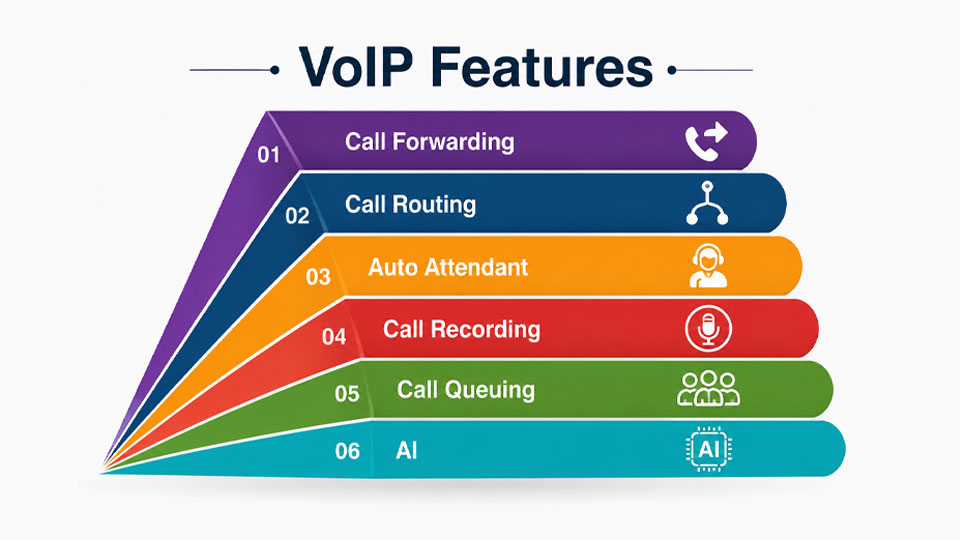
Landline has one feature of its own — that is making and receiving calls, after which it becomes zero. With VoIP, calling and listening is there, but along with it, it brings a golden box of unified communication features.
Call Forwarding: Every call answered — when you feel that you are busy and cannot answer the call, forward the incoming calls to any of your team person, colleague, teammate or co-worker who can answer the call.
Call Routing: Intelligent call routing connects the customer to the right agent or team without any delay. ICR which already knows the caller’s intent, their need, their old talk history data and who is the right agent for this call — transfers that call to that agent.
Auto Attendant: The customer chooses the right department on their own, they do not need any live agent. This is an advanced telephony system that works without a live receptionist — it has a pre-recorded voice that greets the call and sends them to the right department.
Call Recording: Looking at customer service training and compliance, this is a very valuable feature. All calls can be securely recorded, and the transcripts of those recorded calls can be saved in cloud storage, and you can listen to them whenever needed.
Call Queuing: If you receive a lot of calls during the day, if you set these calls according to a queue then no call will be missed and you can easily assign these calls to your caller agent.
AI Voice Bot: An advanced communication solution that automatically handle customer calls with the help of Artificial Intelligence. These bots can talk to customers in a natural way, understand their questions, and provide quick responses.
Reliability
When it comes to landlines, they do not require any type of electricity and continue to work even during a power outage. VoIP, on the other hand, is dependent on a fast speed broadband internet connection — if the power or internet goes out, your entire system shuts down. Therefore, if you are thinking of switching to a VoIP service provider, you must have a reliable internet connection and an electricity backup that keeps your system running continuously.
Scalability
If a business wants to expand its landline phone system, it will need to lay down a lot of wires across the office — which means the process can be lengthy and expensive. VoIP, which is a cloud-based phone system, allows businesses to scale up or down based on their needs. If a business hires a new agent, it can easily add a new phone number and location to the system and increase its capacity without any hassle.
Maintenance
VoIP systems are easy to maintain because they work through the internet and cloud-based technology. Businesses do not need to manage complex wiring or expensive hardware systems like traditional landline phones. Most updates, security patches, and system improvements are handled by the VoIP service provider.
If any issue happens, it can often be fixed remotely without needing an on-site engineer. This helps businesses save both time and maintenance costs. VoIP systems also make it easy to add new users, upgrade features, and manage the complete phone system from a simple online dashboard.
Why Businesses Are Switching from Landline to VoIP Solutions
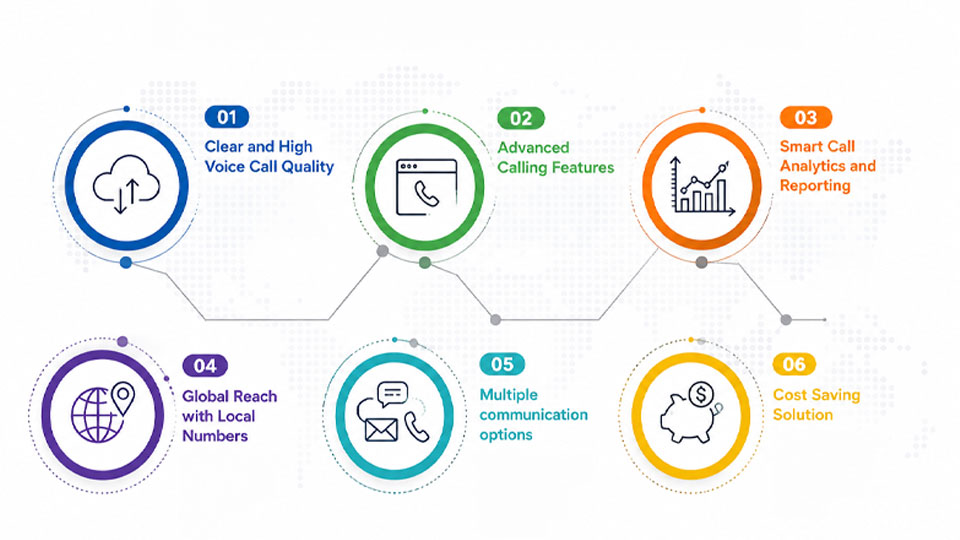
Clear and High Voice Call Quality
With a strong internet connection, VoIP delivers crystal clear call quality. Modern cloud-based VoIP systems use noise suppression technology to reduce disruptive background noise and provide high-definition voice calls, ensuring smooth and professional communication every time.
With VoIP, the voice on a call is crystal clear for both parties, which means there is no need to repeat a question again and again.
Advanced Calling Features
A phone system is not very useful if it only offers a calling option. VoIP not only delivers HD voice call quality but also brings a full package of advanced tools such as call forwarding, call routing, auto attendant, voicemail to email, virtual phone number (Local and toll free DID), video calling, and much more — all under one unified communication system.
Smart Call Analytics and Reporting
With a VoIP phone service, you get a smart analytics dashboard to track real-time agent activity and monitor call metrics. Users can easily track both inbound and outbound calls.
It provides a complete visual view of missed calls, answered calls, total calls, call volume, agent performance, average talk time, total talk time, and many other call reporting views. Landlines, on the other hand, provide no data or insights about your calls at all.
Global Reach with Local Numbers
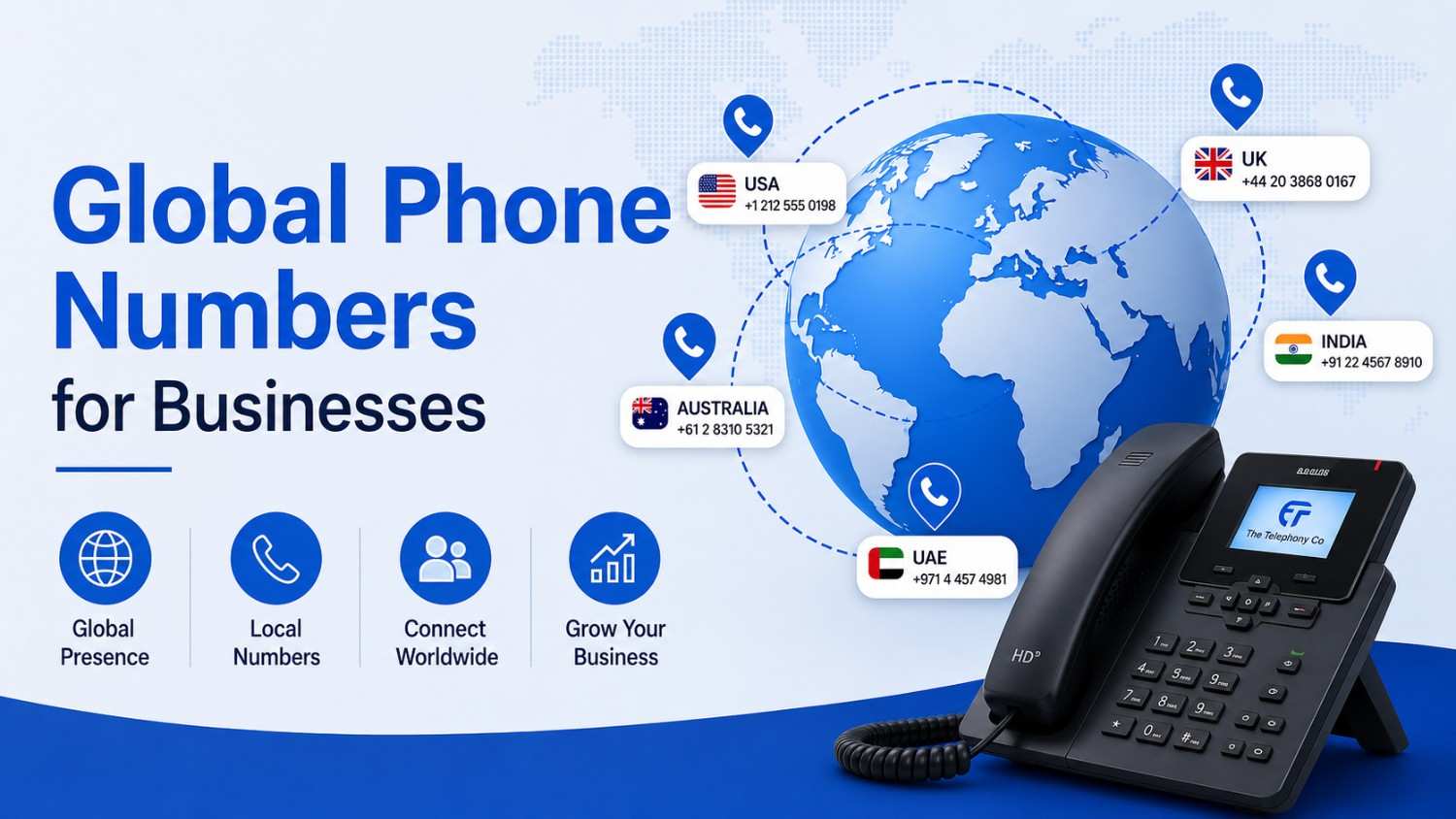
With a landline, getting a local number in another city or country is extremely difficult and expensive. With a The Telephony Co, VoIP service, businesses can get a local phone (DID number) from any country, city or region, which helps them build a local presence without opening a physical office.
Multiple Communication Options
When a business uses a VoIP service, it gets access to many additional communication channels that are connected with VoIP. It also opens the door to a wide range of communication features such as video calling and conferencing, messaging, and team collaboration — all without needing a separate tool or application.
Cost Saving Solution
The cost of a VoIP service is much lower compared to a traditional landline phone system. It is also very affordable to implement and maintain. When it comes to VoIP number, businesses get access to a variety of calling plans such as pay-as-you-go, monthly, and unlimited local and international calls. If we compare the monthly bills of a landline versus VoIP, it becomes clear that businesses can easily save 50% to 60% on their phone bills every month.

Integration with Business Tools
Unlike traditional phone system, VoIP system can easily integrate with CRM systems, helpdesk software, unified communication platform and other business tools. This helps teams work smarter by having all communication and customer data available in one place.
Experience Faster, Smarter, and More Flexible Business Communication
Problems Businesses May Face with VoIP and How to Fix Them
There is no doubt that VoIP is a powerful communication tool, but it can also come with some challenges. These challenges can be resolved with the right solution, careful planning, and the help of the right service provider. Here are some common VoIP challenges:
Complete Dependence on Internet Connection
VoIP is a cloud-based phone system that depends entirely on a stable broadband internet connection. If your internet connection faces any issue, your entire system can come to a halt. The solution to this is that you can also connect it to your mobile data and continue working without any interruption.
Needs Continuous Power Supply
A VoIP system requires electricity 24/7 to function. If there is a power cut, your service can stop, which includes desktop systems. However, if you are using a mobile, tablet, or laptop, a power cut does not cause any problem for those devices. On the other hand, to handle power outages, most companies have backup power solutions in place to keep their services running.
Call Clarity Problems
The quality of a VoIP call depends on your internet speed. If your internet speed is low or too many users are connected to the same network, your call may experience disturbance or even get disconnected.
The solution to this is to use a high-speed broadband internet connection and an advanced router. It is also recommended to use a wired Ethernet connection, which works at a faster speed compared to Wi-Fi.
VoIP vs Landline: Which Is the Best Phone System for Business Communication?
When choosing the right phone system for your business, the decision often comes down to VoIP versus landline. Landlines are reliable but come with high setup costs, expensive maintenance, and very limited features. VoIP, on the other hand, is cost-effective, flexible, and packed with advanced communication features that modern businesses need.
From call forwarding and auto attendant to video calling and team collaboration, VoIP offers everything a business needs to communicate efficiently. It is easy to install, simple to scale, and works perfectly for both in-office and remote teams.
In 2026, a cloud-based VoIP phone system is a better choice for businesses. The Telephony Co is one of the best VoIP service providers, offering reliable, feature-rich, and affordable VoIP solutions designed to meet the needs of every business. The Telephony Co provides services to small and mid-sized businesses and has already become the first choice for businesses globally.