
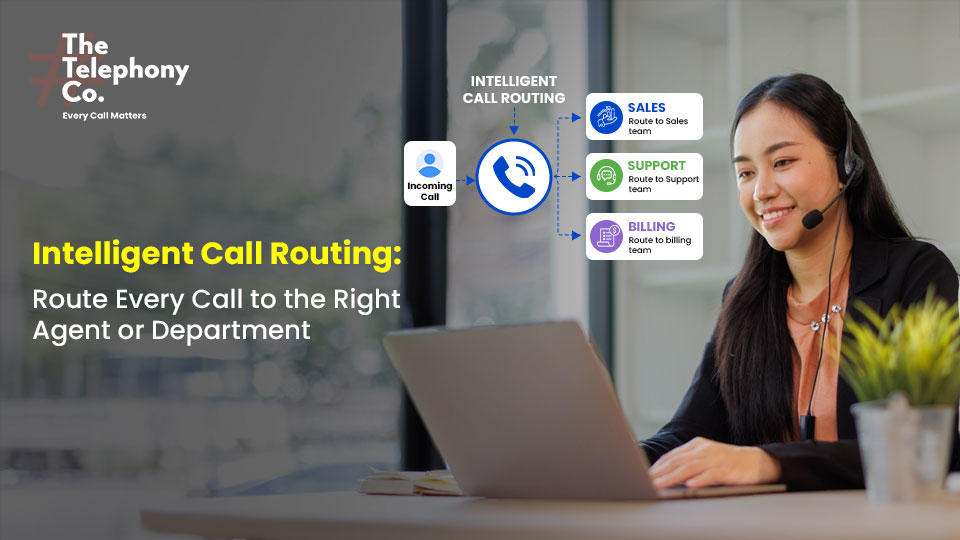
Traditional call routing is playing an important role in a business’s customer support system. It handles inbound calls in a fixed sequence. When a call comes in, the system transfers it to an agent or department based on the option selected by the customer.
However, in traditional routing, customers often have to wait in long queues because most agents are busy. In many cases, the agent who receives the call may not be able to solve the customer’s problem. As a result, the call gets transferred multiple times between different agents or departments.
Intelligent Call Routing (ICR) is an advanced approach that helps businesses make their customer support smarter and more efficient. It does more than just connect calls to agents. It uses AI-based technology to understand the caller’s needs, including their language, call volume, agent availability, expertise, and customer intent.
As a result, each call is directed to the most suitable agent or the right department based on caller information and agent availability, leading to faster and better resolution.
What Is Intelligent Call Routing?
Intelligent Call Routing is an advanced AI-based telecommunication technology that automatically directs incoming calls to the most valuable agent or department. It works based on predefined rules, the caller’s needs, and current agent availability.
It analyzes important factors such as the customer’s call history, intent, preferred language, caller ID, and past interactions. Using this information, the system ensures that each call is connected to the right person who is best equipped to handle the query.
Handle Every Call Efficiently with Advanced
Intelligent Routing System
 Quick Call Routing
Improved Team Efficiency
Increased Productivity
Quick Call Routing
Improved Team Efficiency
Increased ProductivityHandle Every Call Efficiently with Advanced Intelligent Routing System
Quick Call Routing
Improved Team Efficiency
Increased ProductivityHow Does Intelligent Call Routing Work?
Collect Customer Data
The first step is gathering important information about the caller. This data helps the system understand who the customer is and what they might need.
Some common data points include:
- Caller ID (phone number)
- Date and time of the call
- Preferred language
- Reason for calling (via IVR input)
- Customer profile from CRM
- Past communication history
Analyze and Match the Data
Once the data is collected, the intelligent system processes it in real time.
It uses:
- Predefined routing rules
- Customer intent
- Agent skills and availability
Based on this analysis, the system decides the most suitable agent or department for the call.
Smart Routing and Call Handling
After analyzing the data, the system takes action and routes the call in the most efficient way. Instead of random transfers, it follows a smart and structured approach.
Here are some common routing methods used:
Direct Agent Connection
The call is sent straight to a specific agent who is best suited to handle the query.
Intelligent Queue Management
If the right agent is busy, the caller is placed in a smart queue where priority and wait time are optimized.
Guided Self-Service
The caller is offered IVR system to solve simple issues without needing an agent.
Key Benefits of Intelligent Call Routing
If you’re still on the fence, here’s why businesses that switch to an intelligent call routing system rarely go back.
Shorter Wait Times
When calls go directly to the right person, customers spend less time on hold. Less hold time means happier customers — it’s that simple.
Higher First-Call Resolution Rates
When the right agent answers from the start, problems get solved in a single call. No bouncing around, no callbacks, no frustration.
Improved Agent Efficiency
Agents stop wasting time handling calls outside their expertise. Skills-based routing means every call is a good fit for the person answering it.
Better Customer Experience
Customers feel heard and valued when they’re not passed around. A smooth, efficient call leaves a lasting positive impression.
Reduced Operational Costs
Fewer transfers, shorter calls, and better agent utilization all add up to significant cost savings over time.
Real-World Example: How Smart Routing Transforms Customer Support
Let’s look at a practical example.
Before intelligent call routing: A mid-sized e-commerce company receives around 300 calls per day. Calls come in through a generic number and are manually assigned by a receptionist. Customers frequently get transferred 2–3 times before reaching the right agent. Average call handling time: 9 minutes. Customer satisfaction score: 64%.
After implementing The Telephony Co’s intelligent call routing system: An IVR menu captures the reason for each call. Skills-based routing connects customers to the right agent on the first try. ACD ensures calls are evenly spread across the team. Average call handling time drops to 5 minutes. Customer satisfaction score jumps to 89%.
Same team. Same number of calls. Dramatically better results — just because of smarter call routing.
Intelligent Call Routing vs. Traditional Call Routing: What's the Difference?
Here’s a simple comparison table to clearly understand the difference:
| Feature | Traditional Call Routing | Intelligent Call Routing |
| Routing logic | Fixed, manual | Dynamic, data-driven |
| Personalization | None | High (based on caller history) |
| Wait time | Long | Significantly reduced |
| First-call resolution | Long | Much higher |
| Scalability | Limited | Easily scalable |
| Agent productivity | Average | Optimized |
| IVR integration | Basic | Advanced |
Getting Started: What to Look for in an Intelligent Call Routing System
If you’re evaluating solutions, here are the key features to prioritize:
Flexible routing rules — Can you customize routing based on your specific business logic?
IVR software with natural language support — Can callers speak naturally, or are they stuck pressing numbers?
ACD capabilities — Does the system distribute calls fairly and efficiently across your team?
Real-time monitoring — Can managers see what’s happening and make adjustments on the fly?
Reporting and analytics — Are you getting the data you need to continuously improve?
Easy integration — Does it connect with your existing CRM, helpdesk, or business tools?
Scalability — Will it grow with your team without requiring a complete overhaul?
How The Telephony Co Makes Intelligent Call Routing Easy
Setting up a complex routing system used to require expensive hardware, lengthy IT projects, and a team of specialists. Not anymore.
The Telephony Co offers a fully cloud-based intelligent call routing service that businesses can set up quickly, without technical headaches. Here’s what makes it stand out:
- Drag-and-drop call flow builder — Create and customize routing rules visually, no coding required
- CRM integration — Connects with tools like Salesforce, HubSpot, and Zoho to pull caller data in real time
- Multi-level IVR software — Build smart menus that guide callers to exactly what they need
- Real-time analytics dashboard — See call volumes, routing performance, and agent stats at a glance
- Omnichannel support — Route not just calls, but also chats and messages through one unified platform
- 24/7 failover routing — If an agent or office is unavailable, calls automatically reroute to keep things running smoothly
Whether you’re a startup or an established enterprise, The Telephony Co makes automated intelligent call routing accessible, affordable, and genuinely easy to manage
Conclusion
Every time a customer picks up the phone and calls your business, they’re giving you a chance to impress them, solve their problem, and build loyalty. Wasting that opportunity on long hold times, wrong transfers, and frustrated handoffs is a cost no business can afford.
Intelligent call routing turns every incoming call into a smooth, efficient, and positive experience — for your customers and your team. With the right system in place, you’re not just routing calls. You’re routing trust, satisfaction, and growth.